
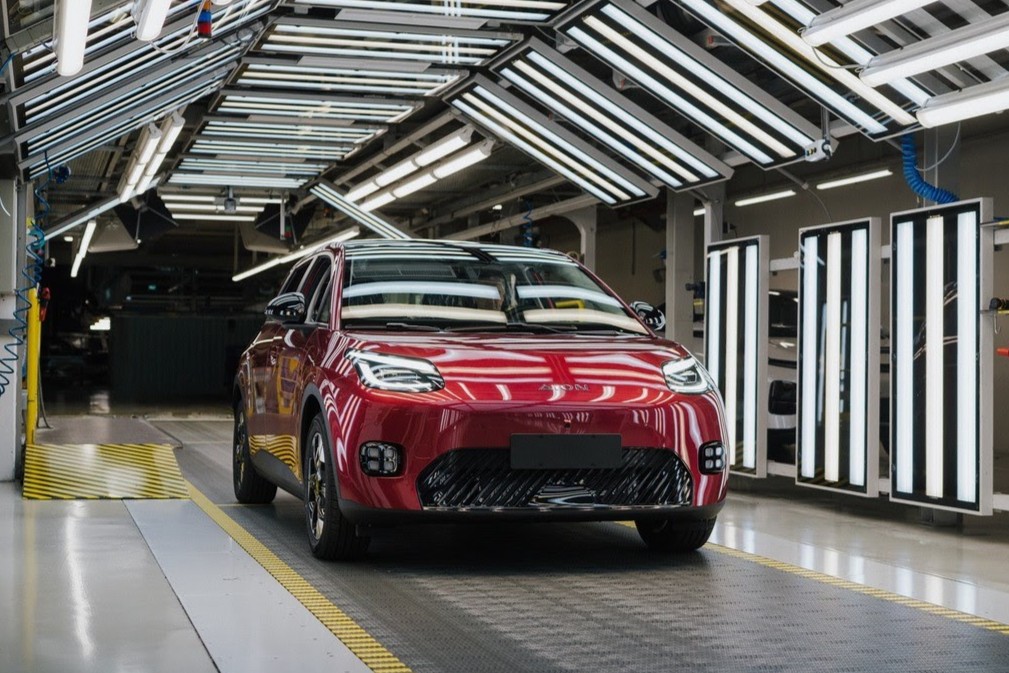
Contract manufacturer Magna Steyr has begun production of the compact electric vehicle GAC Aion UT in Graz, marking the second model from China’s GAC Group to be built at the Austrian facility after the GAC Aion V.
The move signals a further step in GAC’s localisation strategy in Europe, as Chinese automakers increasingly shift production to the region to mitigate tariffs and expand market access.
Production of the Aion UT follows shortly after Magna Steyr began assembling the Aion V in November 2025, underscoring the rapid expansion of the partnership. The cooperation stems from a broader agreement signed between GAC and Magna in November 2025, which covered multiple vehicle programmes beyond the initial SUV.
The Aion UT, a battery-electric compact car already produced in China and Thailand, has been available in its domestic market since March 2025. The model recently made its European debut at the Motion Expo in Graz, reinforcing expectations of local production.
Battery supply for the European-built models comes from Farasis Energy, which is providing lithium iron phosphate (LFP) cells. GAC had previously confirmed that both the Aion UT and Aion V would use these batteries, indicating early on that the compact model would also be manufactured in Europe.
According to the companies, the total battery order exceeds 10 GWh, theoretically sufficient for around 100,000 electric vehicles equipped with 100 kWh packs. However, the precise battery specifications for the Aion UT remain undisclosed.
Magna’s facility in Graz is increasingly positioning itself as a key production hub for Chinese electric vehicle manufacturers entering Europe. Since September, the plant has also been assembling the Xpeng G6 and Xpeng G9 from Xpeng.
By producing vehicles locally, manufacturers can avoid additional European Union tariffs imposed on electric cars imported from China, improving competitiveness in the region.
Magna Steyr is responsible solely for manufacturing, while sales and distribution of GAC vehicles remain under the control of the Chinese automaker. GAC has indicated plans to expand into additional European markets through new partnerships and service networks, although specific countries and production volumes have not been disclosed.
The Graz plant operates a flexible mixed-production system, enabling the assembly of internal combustion engine vehicles, hybrids and electric models on the same lines. Current electric models produced at the site include the Mercedes-Benz G-Class EQ, while legacy programmes such as the Jaguar I-Pace and Fisker Ocean have been discontinued. Conventional models like the BMW Z4 and Toyota Supra continue to be produced.