
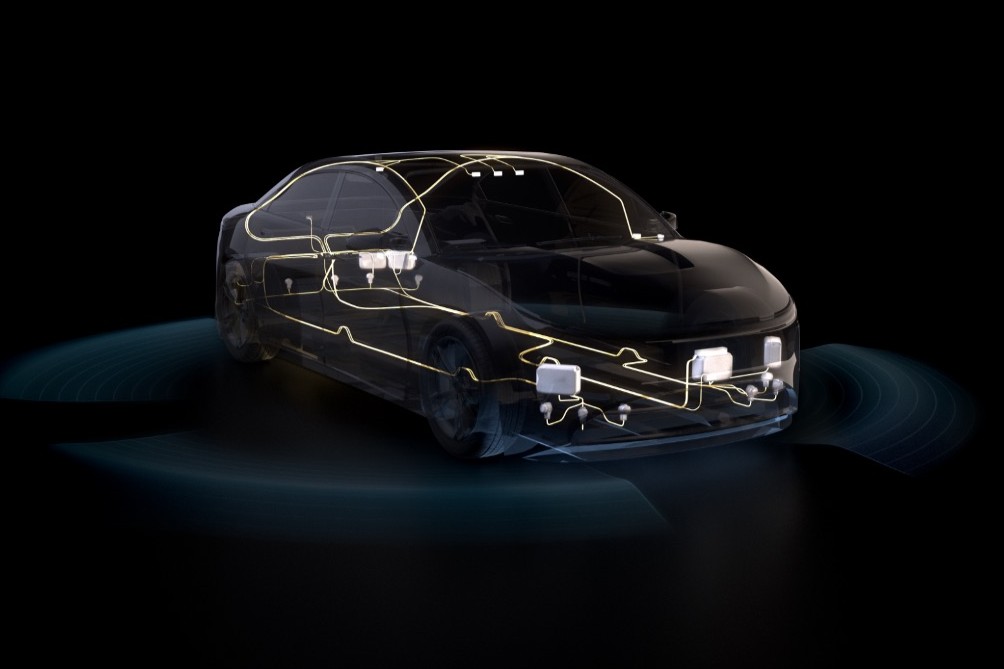
Nvidia has announced a series of new and expanded partnerships with automakers and mobility providers, as its Drive Hyperion platform gains adoption for advanced driver assistance and Level 4 autonomous driving applications.
At its GTC 2026 conference, the U.S. technology company said automakers including BYD, Geely, Isuzu, and Nissan plan to deploy its platform in future vehicles, while Hyundai and Kia will deepen their collaboration. Ride-hailing platforms Uber and Bolt are also expanding their use of Nvidia’s technology for robotaxi services.
See also: Cyngn Uses NVIDIA Isaac Sim to Accelerate Validation of Autonomous Industrial Vehicles
Nvidia’s Drive Hyperion platform combines high-performance computing hardware with artificial intelligence software, enabling real-time decision-making within vehicles. The system is designed to support advanced autonomy without relying on cloud processing.
“The autonomous vehicle revolution is here — the first multitrillion-dollar robotics industry,” said Jensen Huang, founder and CEO of Nvidia. “Everything that moves will eventually be autonomous. The NVIDIA Hyperion platform and our Alpamayo open reasoning models give vehicles the ability to perceive their surroundings, reason through complex situations and act safely — making scalable, level 4 autonomy possible.”
See also: Mercedes-Benz Taps Nvidia, Momenta and Uber to Launch S-Class Robotaxi Network
Uber said it will expand its partnership with Nvidia to deploy robotaxis using the Drive Hyperion platform and the Alpamayo AI model. The rollout is expected to begin in Los Angeles and San Francisco in the first half of 2027, with plans to expand to 28 cities across North America, Europe, Australia, and Asia by 2028.
“Autonomous technology holds enormous promise to make transportation safer, more reliable, and more accessible,” said Dara Khosrowshahi, CEO of Uber. “By expanding our partnership with NVIDIA and combining advanced AI with Uber’s global network and operating experience, we are laying the foundation for an increasingly multi-player AV world.”
Hyundai Motor Group and its affiliate Kia are also broadening their collaboration with Nvidia, including plans to integrate Level 2 driver assistance systems into production vehicles. The companies are also working with Motional, a joint venture with Aptiv, to advance Level 4 robotaxi capabilities.
See also: Hesai Selected by Nvidia as LiDAR Partner for Drive Hyperion L4 Platform
“The expanded partnership with NVIDIA marks an important milestone in realizing Hyundai Motor Group’s vision for safe and reliable autonomous driving technology,” said Heung-Soo Kim, Executive Vice President and Head of the Global Strategy Office at Hyundai Motor Group. “Based on a unified, Group-wide collaborative framework, we will strengthen our differentiated technological competitiveness — from Level 2 and above autonomous driving technology to Level 4 robotaxi services.”
Separately, Isuzu is collaborating with Japanese startup Tier IV to develop Level 4 autonomous buses using Nvidia’s Drive AGX Thor system-on-a-chip. “This collaboration marks a definitive milestone for autonomous transit,” said Shinpei Kato, founder and CEO of Tier IV. “By fusing Isuzu’s legendary engineering with NVIDIA’s Thor AI compute, we have built an unmatched foundation for Level 4 transit driven by Autoware.”
See also: Nvidia Unveils ‘Thinking’ Autonomous Driving AI Alpamayo, to Debut on U.S. Roads With Mercedes CLA
In Europe, Estonian mobility platform Bolt is also working with Nvidia to develop an AI foundation for scaling autonomous vehicles, combining Nvidia’s platform with Bolt’s fleet data. The company has also partnered with Pony.ai to integrate Level 4 autonomous driving technology into its services, with initial trials planned for 2026.
The announcements underscore Nvidia’s growing role in the automotive sector, as automakers and mobility providers seek to accelerate the development and deployment of autonomous driving systems.