
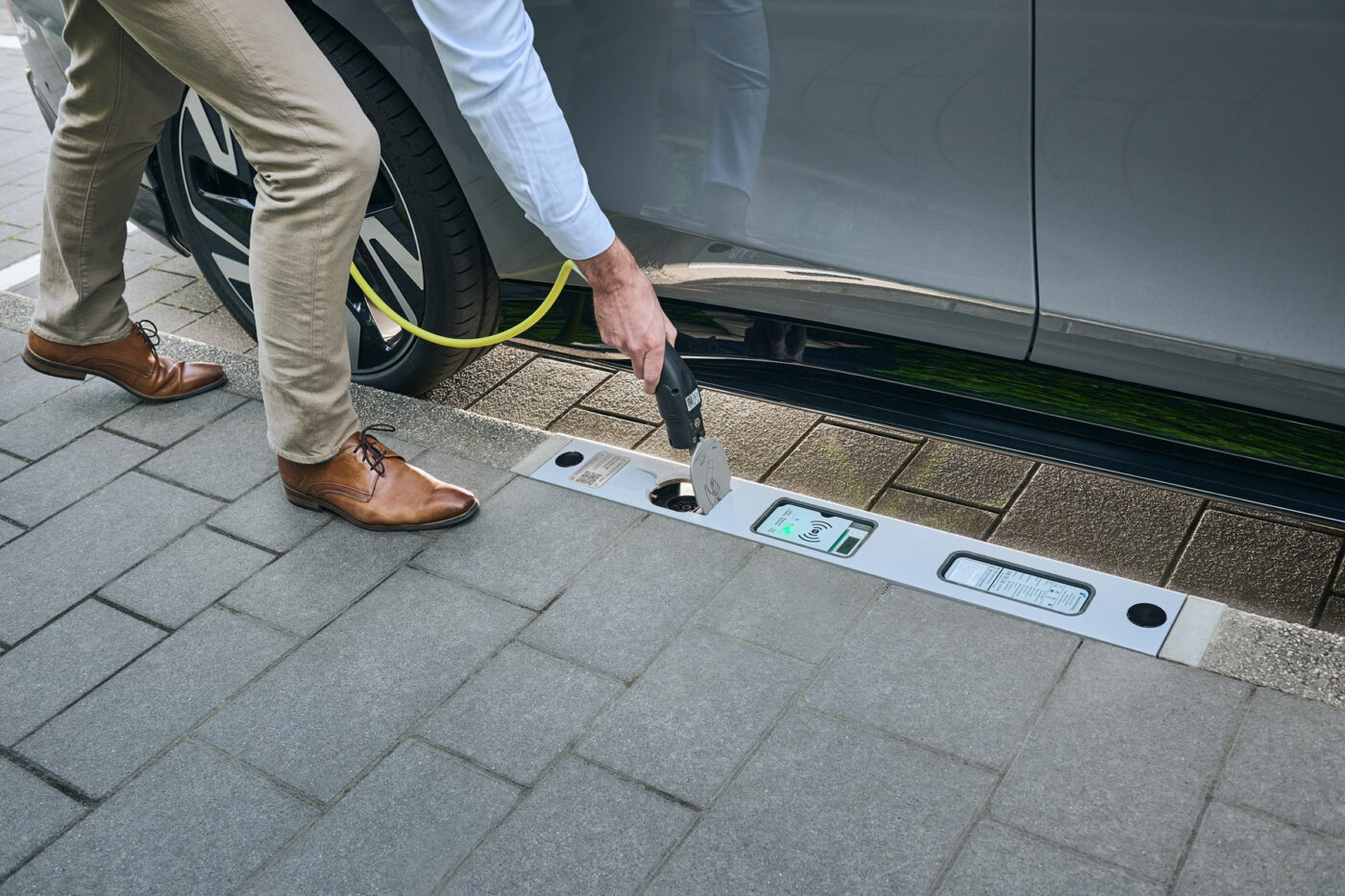
Mobility services provider DKV Mobility has partnered with German defence and technology group Rheinmetall to integrate Rheinmetall’s sidewalk charging solution, known as the Ladebordstein or “charging curb,” into DKV’s charging ecosystem.
The collaboration will make the charging technology available to DKV Mobility customers in Germany for the first time on a broader scale, the companies said.
Previously deployed only in small pilot projects, the charging curb system embeds EV charging hardware directly into the roadside curb rather than using traditional wallboxes or freestanding charging stations.
Under the new partnership, DKV Mobility will offer the solution to its corporate fleet customers, enabling companies operating battery-electric vehicles or plug-in hybrids to install the infrastructure on their own premises where site conditions permit.
DKV Mobility will integrate the hardware into its existing digital charging ecosystem, allowing users to access services such as charging session management and billing through the company’s platform.
“By integrating the Rheinmetall charging curb, we are expanding our charging ecosystem with an innovative and, to date, unique solution in the market,” said Sven Mehringer. “The charging kerbstone opens up additional possibilities, particularly for corporate sites where traditional charging stations have limited applicability.”
The system is designed as a compact AC charging solution for locations where space constraints or aesthetic considerations make conventional charging stations difficult to install.
The technology has already been tested in a pilot project conducted by Rheinmetall together with TankE and the City of Cologne. After the trial concluded, the charging points remained in operation.
Feedback from around 100 test users highlighted both advantages and limitations of the curb-integrated charging concept in everyday use.
Rheinmetall said the technology could also attract interest in other markets where street-level charging infrastructure is being encouraged. In the United Kingdom, for example, authorities introduced a £25 million Pavement Channels Grant programme last year to support the installation of pavement charging channels that allow EV owners without private parking to charge vehicles at home.
Because the charging curb is integrated directly into the pavement, it can also reduce the visual impact often associated with standalone charging posts—an issue frequently considered in urban planning approvals.
Berthold Franz said the system has already been deployed internally within Rheinmetall facilities.
“By connecting the charging kerbstones to the DKV Mobility backend, we have already successfully integrated the system at our own locations,” Franz said.
He added that the experience gained from internal use is expected to support wider adoption by companies looking for practical EV charging infrastructure for their fleets.
“This means other businesses can benefit from the Rheinmetall charging kerbstone,” Franz said. “Together, we combine our hardware innovation with DKV Mobility’s operational expertise to deliver a practical charging solution for corporate environments.”