
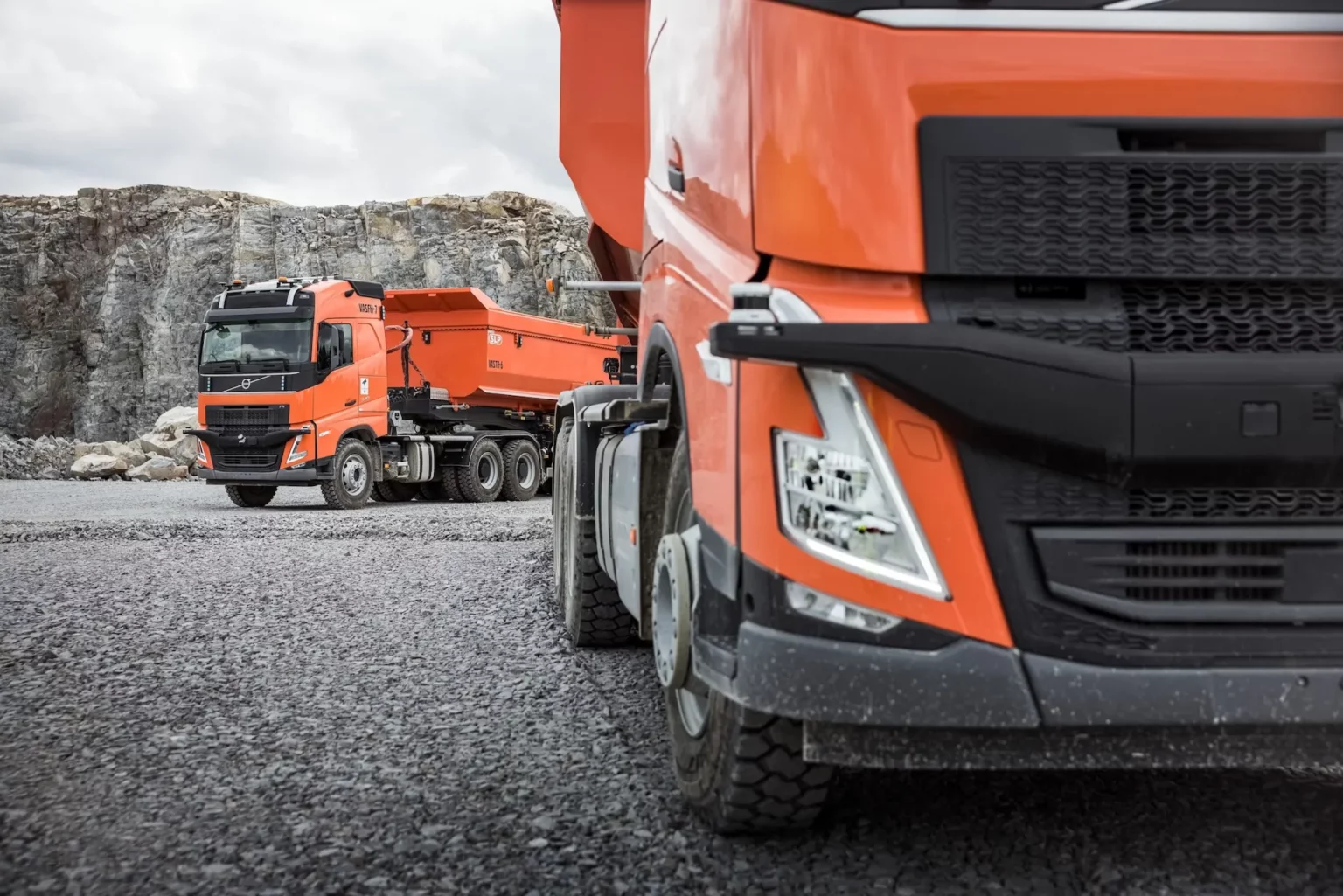
Engineers at Volvo Autonomous Solutions have developed a distinctive front-mounted sensor enclosure for the Volvo FH Autonomous, designed to meet the durability, maintenance and scalability requirements of mining and quarry operations.
Nicknamed the “mustache” by Volvo engineers, the sensor bar houses the full perception stack required for driverless operation, including three lidar units, one radar, two inertial measurement units and a camera. The system relies on sensor fusion to generate a real-time environmental model that enables autonomous navigation in harsh, unpaved environments.
A key design decision was to mount the sensor bar directly to the truck’s chassis rather than the cab. Volvo said this provides a more stable reference point, as the cab is subject to suspension movement, tilting and vibration. By contrast, the chassis offers consistent geometry, improving sensor calibration and accuracy over time.
Mining trucks operate under extreme conditions, including heavy payloads, uneven haul roads, dust, mud and debris. Volvo said the mustache has been validated through simulation and physical testing, including exposure to potholes, steep gradients and adverse weather. To address lens contamination, the company integrated air and water cleaning systems into the enclosure, allowing sensors to be cleaned without compromising durability.
The sensor bar was also designed with production scalability in mind, using Volvo’s Common Architecture & Shared Technology (CAST) framework. This approach standardises hardware modules across platforms, enabling repeatable builds and simplified upgrades. The mustache is divided into three functional zones, with a central sensor stack and two side-mounted lidar units, allowing components to be replaced individually.
“The goal was to build something that works reliably in the toughest operating environments while still being practical to service at scale,” Volvo engineers involved in the project said, noting that modularity allows damaged sensors or brackets to be swapped without dismantling the entire assembly.
To minimise changes to the base vehicle, Volvo reused existing mounting points on the standard FH truck. One of the front footsteps normally used for cab access was removed and its attachment points repurposed for the sensor bar, avoiding new structural modifications and keeping the certified vehicle architecture largely intact.
Volvo said serviceability was a core consideration throughout development, with engineers working alongside maintenance teams to ensure components are accessible and replacement times are kept short. Pre-assembled spare modules can be kept on hand to reduce downtime in operational fleets.
The company said the current design reflects several years of iteration as sensor technology has evolved, with smaller and higher-resolution lidar units replacing earlier, bulkier hardware. Volvo Autonomous Solutions said it plans further refinements as sensor suppliers, cleaning systems and autonomous use cases continue to develop.