
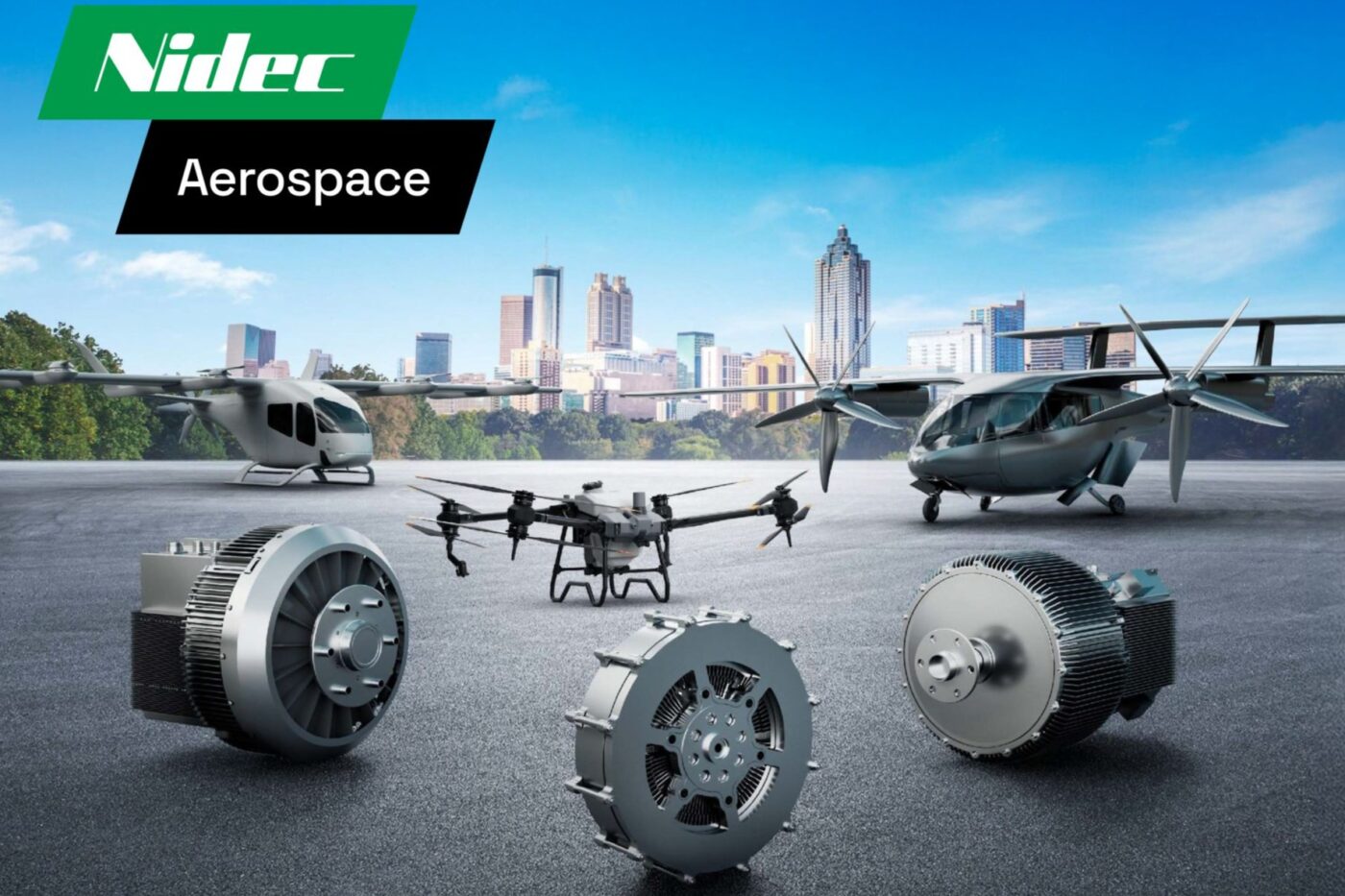
Nidec Aerospace, the electric aviation joint venture between Japan’s Nidec and Brazil’s Embraer, is establishing a new location in Atlanta, Georgia, as it steps up development of electric propulsion systems for next-generation aircraft.
The Atlanta site will complement the company’s existing headquarters in St. Louis, Missouri, and is intended to support closer collaboration with customers, suppliers and research institutions as electric aviation programmes move from development toward certification and deployment.
See also: Renesas and Nidec Unveil ‘8-in-1’ E-Axle Proof of Concept for Electric Vehicles
“Our presence in Atlanta strengthens the momentum for our customers and the entire industry,” said Vincent Braley, chief executive of Nidec Aerospace. “As electric propulsion programmes advance towards practical deployment, physical proximity becomes crucial. This move allows us to work faster, integrate earlier, and deliver reliable, certifiable propulsion solutions that accelerate projects from the prototype stage to deployment.”
Nidec and Embraer announced the formation of the joint venture in June 2023, completing the transaction in October that year. While the initial focus was on propulsion systems for electric vertical take-off and landing aircraft, or eVTOLs, the venture has since broadened its scope to include electric short take-off and landing aircraft, conventional fixed-wing aircraft and drones.
See also: Eve Air Mobility Secures $20 Million Investment from Nidec Aerospace
The company’s first customer was Eve Air Mobility, in which Nidec acquired a stake in mid-2024. Eve is developing an eVTOL aircraft that uses a distributed electric propulsion architecture, a configuration that relies on multiple coordinated electric motors rather than a single power unit.
Such systems are widely seen as one of the most complex challenges in electric aviation, requiring precise integration of motors, inverters, control computers and high-voltage cabling. Nidec Aerospace is developing a distributed electric propulsion system designed to meet those requirements.
Eve’s first aircraft will feature eight electronically controlled lift rotors, complemented by a pusher motor supplied by Beta Technologies to improve efficiency during cruise flight. The programme recently secured $150 million in loan financing, underlining investor confidence in the sector despite ongoing technical and certification hurdles.
Nidec Aerospace said Atlanta was chosen for its global connectivity, access to aerospace and engineering talent, and proximity to major research universities, factors it believes will support its long-term innovation strategy as electric propulsion moves closer to commercial reality.