
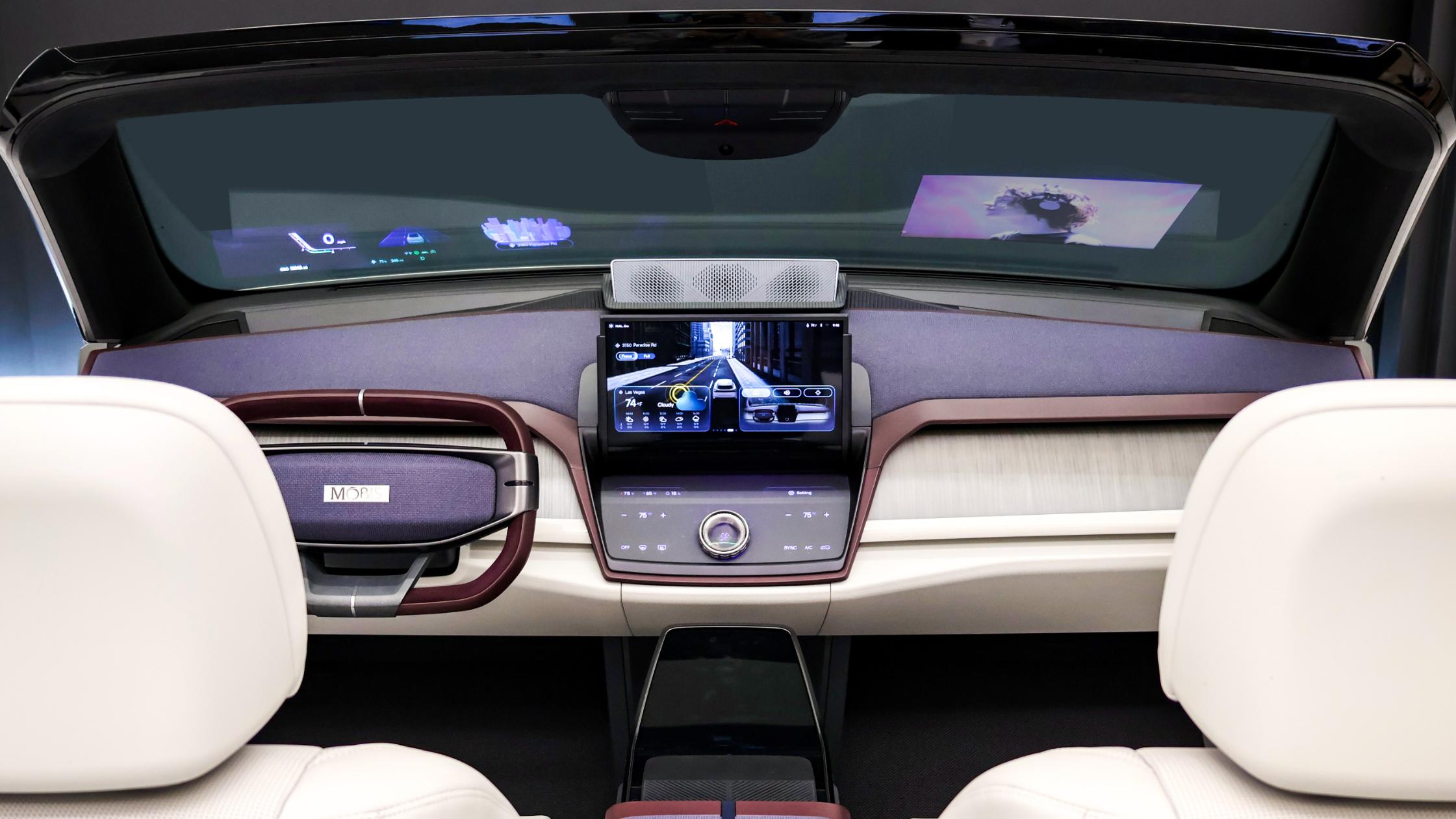
Hyundai Mobis said it has partnered with three European technology specialists to accelerate the development and mass production of holographic windshield displays, aiming to secure a leading position in next-generation in-vehicle display systems.
The South Korean auto parts maker announced the formation of a so-called “Quad Alliance” with Germany-based ZEISS, tesa, and France’s Saint-Gobain Sekurit. The collaboration brings together expertise in optics, adhesive technology and automotive glazing to commercialise holographic windshield displays (HWD) by 2029.
See also: Hyundai Mobis Develops 5G-Based Integrated Telematics Unit for Connected Cars
The HWD technology projects driving and infotainment information directly onto a vehicle’s front windshield, eliminating the need for a separate physical screen. It uses a holographic optical element (HOE) film laminated within the glass to display content at the driver’s eye level, allowing key information to be viewed without diverting attention from the road.
According to Hyundai Mobis, the system achieves glass-like transparency of more than 92% and brightness levels exceeding 10,000 nits, enabling clear visibility even in bright daylight. The optical design also restricts the driver’s view of passenger-side content, allowing passengers to use entertainment functions while helping minimise driver distraction.
See also: Hyundai Mobis and Qualcomm Agree to Co-Develop SDV and ADAS Technologies
Under the alliance, Hyundai Mobis will lead system design and overall integration of the display and projection technology. ZEISS will be responsible for optical design and development of the HOE film, tesa will support mass replication of holographic films, and Saint-Gobain Sekurit will handle the precision bonding of the film to the windshield glass.
The company said the collaboration establishes a “one-stop supply chain solution” covering optical design, film replication and system assembly, intended to ensure quality and reliability at mass-production scale.
Hyundai Mobis has showcased prototype vehicles equipped with holographic windshield displays at major international auto shows including CES, IAA Mobility in Germany and the Shanghai Motor Show. At CES 2026 in the United States, the technology received an innovation award, the company said.
See also: Hyundai Mobis Ramps Up In-House Chip Design to Reduce Supplier Dependence
“Through this core technology that unlocks the future of automotive displays, we will provide differentiated value to our customers,” said Jung Soo-kyung, executive vice president and head of the company’s automotive electronics business unit. “We will closely collaborate with global partners through the mass production phase to maximise our technological competitiveness.”