
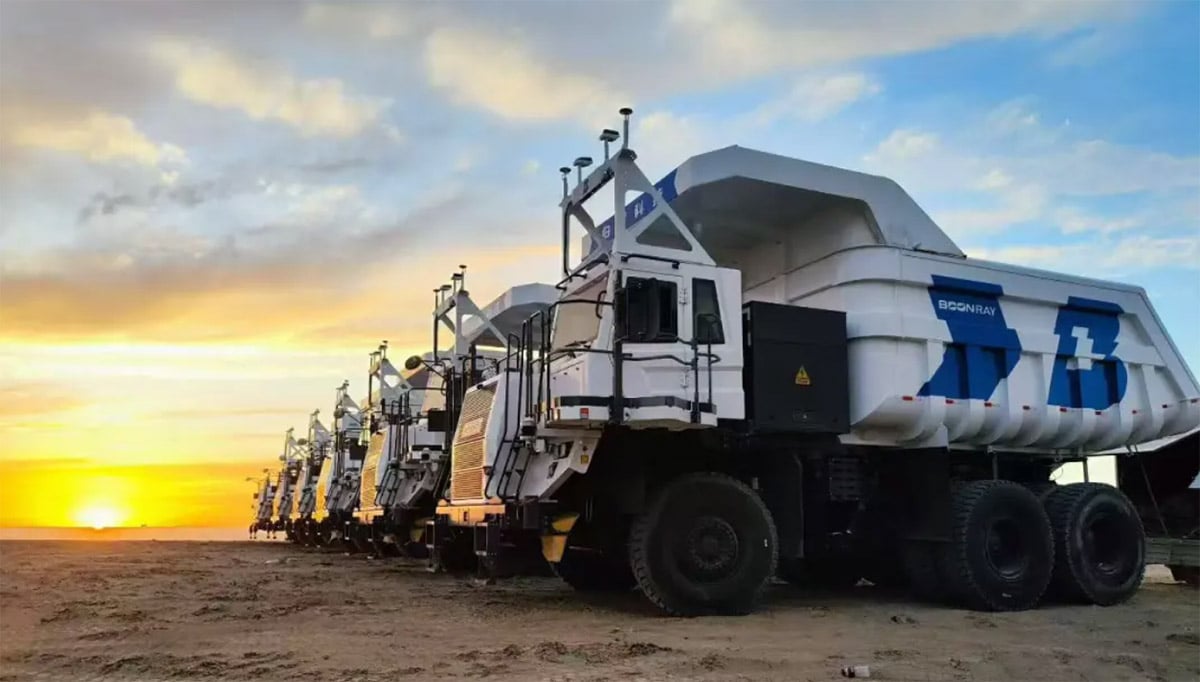
Chinese new energy vehicle and battery maker BYD has made a strategic investment of 100 million yuan ($14.4 million) in Shanghai-based Boonray Technology, underscoring growing momentum behind electrification and automation in the heavy-duty mining industry.
Boonray said on Thursday the funding reflects BYD’s recognition of the company’s technology and business model in electric and autonomous mining trucks. The capital will be used to strengthen research and development, accelerate domestic and overseas expansion, and deepen industrial cooperation.
See also: BYD Targets 1.3 Million Overseas Vehicle Sales In 2026, Executive Says
The two companies plan to collaborate on technology development, supply chain optimisation and scenario-specific product exploration, Boonray said, with the aim of accelerating the adoption of new energy and intelligent technologies in mining and other heavy industries.
“Boonray’s technological systems in unmanned mining and green energy supply are impressive, and its solutions effectively address key operational challenges in traditional mining operations,” said Li Qian, BYD’s board secretary and chief investment officer. BYD will work with Boonray to provide competitive Chinese solutions for the green transformation of global mining and heavy industry, she added.
See also: Ford in Talks With BYD Over Hybrid Battery Supply, WSJ Reports
Founded in 2015, Boonray focuses on autonomous driving research and development for the mining sector. The company’s systems support Level 4 autonomous operation for mining trucks, including unmanned battery swapping, according to Boonray. It has completed more than 30 mining projects across different ore types and complex operating environments, the company said earlier this month.
The investment comes as China’s heavy-duty truck market rapidly electrifies. Domestic sales of new energy heavy-duty trucks reached a record 45,300 units in December, accounting for 53.89% of total heavy-duty truck sales of 84,000 units, according to data from CV World. This marked the first time the penetration rate of new energy models in the segment exceeded 50%, although analysts expect the pace to fluctuate as incentive policies evolve.