
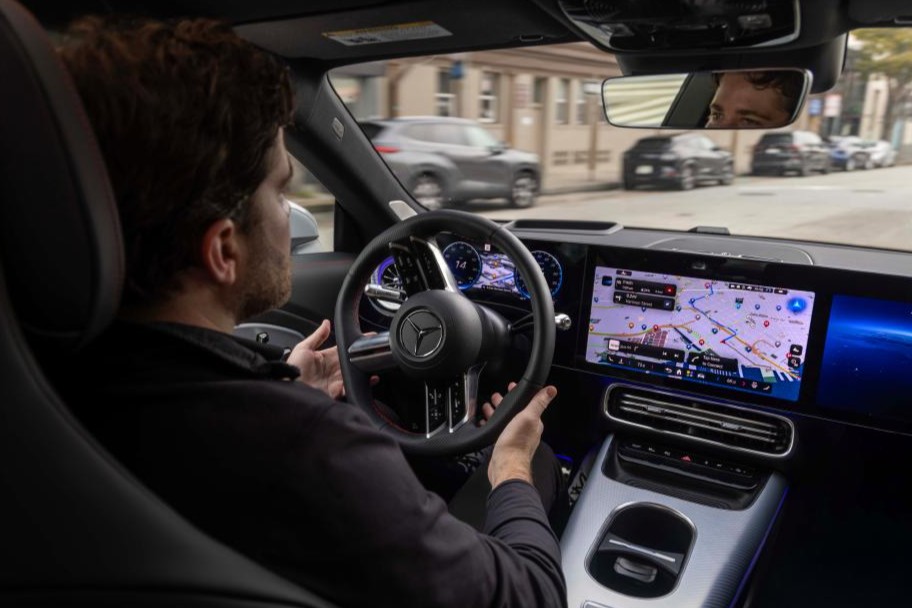
Mercedes-Benz has introduced a new advanced driver assistance system, MB.Drive Assist Pro, expanding its automated driving capabilities with a focus on urban environments while stopping short of full autonomy.
The system has been launched first in China with the battery-electric CLA, developed in cooperation with Chinese autonomous driving specialist Momenta. In the United States — and potentially Europe at a later stage — Mercedes-Benz is instead working with U.S. technology group Nvidia, highlighting a region-specific partnership strategy for its automated driving roadmap.
See also: Nvidia Unveils ‘Thinking’ Autonomous Driving AI Alpamayo, to Debut on U.S. Roads With Mercedes CLA
MB.Drive Assist Pro operates at SAE Level 2, meaning the vehicle can handle steering, acceleration and braking in complex city traffic at the press of a button, from a parking space to the destination. However, drivers remain responsible at all times and must keep their eyes on the road. While hands-free driving is permitted, activities such as smartphone use are not. Mercedes also describes a “cooperative steering approach,” allowing drivers to make steering inputs without deactivating the system, though they must be ready to take over immediately if prompted.
The system relies on around 30 sensors, including ten cameras, five radar units and twelve ultrasonic sensors. These feed raw data into an onboard supercomputer delivering up to 508 trillion operations per second (TOPS), powered by an Nvidia AI chip. The underlying software platform, known as Drive AV, is also supplied by Nvidia. Mercedes said it will be the first automaker to bring Nvidia’s Drive AV system onto public roads in the United States, starting later this year with the new CLA.
See also: Mercedes-Benz to Roll Out City Driving Assist System in U.S., Challenging Tesla
“As the automotive industry embraces physical AI, NVIDIA is the intelligence backbone that makes every vehicle programmable, updatable and perpetually improving through data and software,” said Ali Kani, Nvidia’s vice president of automotive. “Starting with Mercedes-Benz and its incredible new CLA, we’re celebrating a stunning achievement in safety, design, engineering and AI-powered driving that will turn every car into a living, learning machine.”
In the U.S. market, MB.Drive Assist Pro will be offered at a price of $3,950 for three years of use, after which additional fees will apply. By comparison, Tesla’s Full Self-Driving (FSD) package costs about $8,000 as a one-time purchase or $99 per month via subscription. Both systems currently operate at Level 2, although Tesla has long promised future upgrades to higher levels of autonomy, a timeline that remains uncertain.
See also: Mercedes-Benz to Reshuffle Senior Management as Electrified Powertrain Chief Departs
Unlike emerging robotaxi services that target SAE Level 4 autonomy in limited operational areas, Mercedes’ new system is positioned as a premium driver assistance feature rather than true self-driving technology. It is expected to require regular driver intervention, particularly in dense urban traffic.
At the same time, Mercedes-Benz continues to invest in higher levels of automation. The company is currently the only automaker offering certified Level 3 automated driving in both Germany and the United States with its Drive Pilot system, available in the S-Class and EQS. Drive Pilot allows “hands-off, eyes-off” driving in specific conditions, though drivers must be ready to resume control within ten seconds. Its use is currently limited to motorways and capped at speeds of up to 95 km/h in Germany.
See also: Mercedes-Benz Unveils 2027 CLA Hybrid With New 48V Powertrain and MB.OS Platform
Looking further ahead, Mercedes-Benz said its collaboration with Nvidia also underpins development of a Level 4 “chauffeur” experience, intended to combine luxury, safety and advanced autonomy. The next-generation S-Class is expected to play a central role in that strategy and is widely anticipated to be fully electric, as Mercedes plans to phase out separate naming for electric-only models such as EQS.