
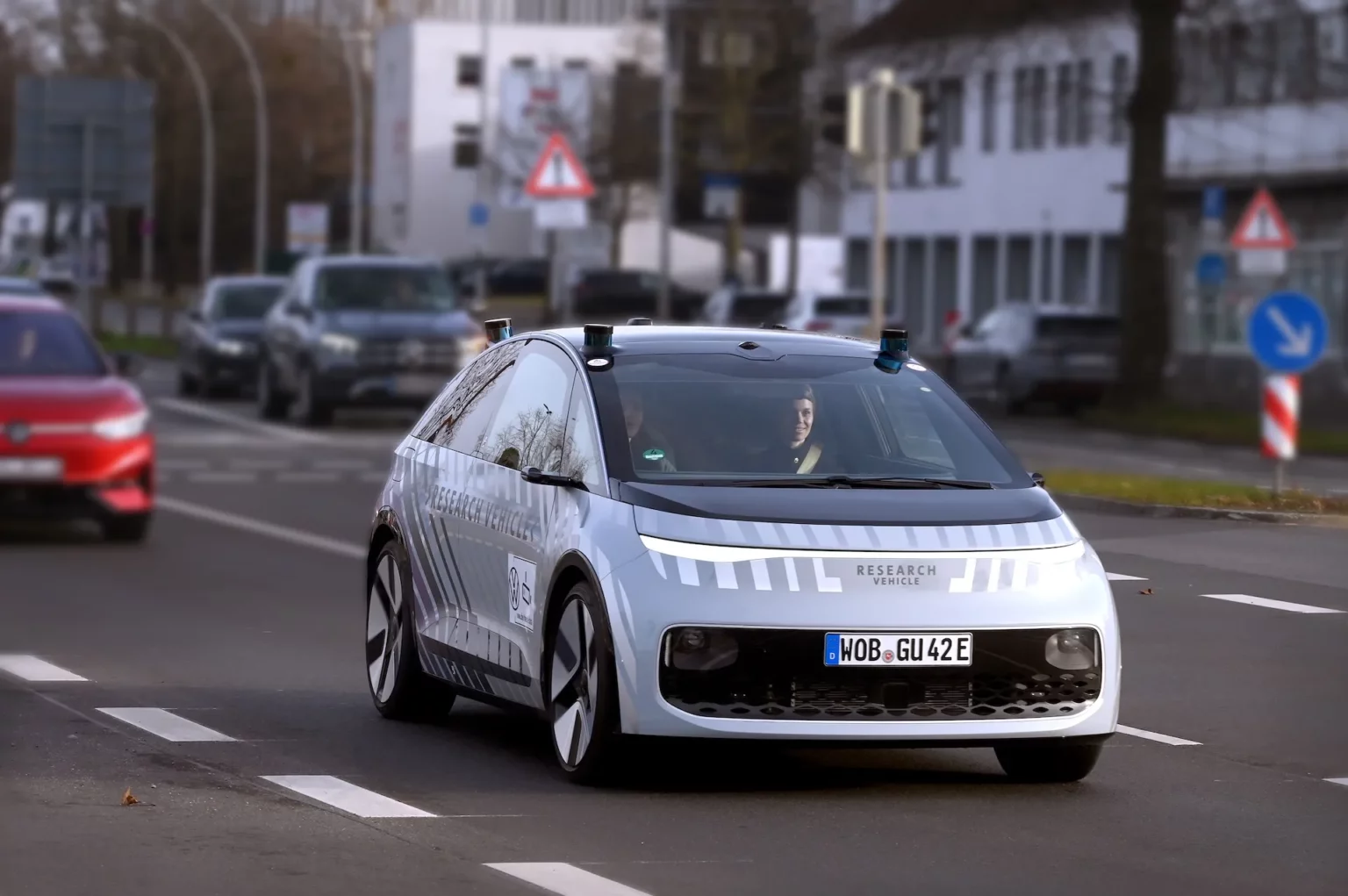
Volkswagen Group has started a new phase of autonomous driving tests with its Gen.Urban research vehicle in Wolfsburg, Germany, focusing on passenger interaction and trust in real-world urban traffic conditions.
The Gen.Urban is a fully autonomous research platform designed without a steering wheel or pedals and is not intended for commercial use. The trials are being conducted on public roads in Wolfsburg to better understand how passengers experience and interact with self-driving vehicles in everyday traffic environments.
See also: Norway’s Ruter Partners with Volkswagen’s Moia to Deploy Autonomous ID. Buzz Shuttles in Oslo
According to Volkswagen, the testing program aims to assess passenger behavior, comfort levels and confidence while traveling in an autonomous vehicle. The research focuses on how occupants use their time during journeys and how interior design, digital interfaces and vehicle behavior influence acceptance of autonomous technology.
The vehicle’s interior is designed around personalization and user experience. Passengers can adjust settings such as cabin temperature, lighting and seating preferences before entering the vehicle or while onboard. The system uses artificial intelligence to adapt displays, lighting and sound themes based on individual user profiles.
See also: Volkswagen’s Moia Exits Hanover to Focus on Hamburg and Autonomous Mobility
The study is being led by an interdisciplinary team from Volkswagen Group Innovation, including designers, software developers and human factors specialists. Data gathered during the trials will be used to inform future user experience concepts across the Group’s brands.
During the current testing phase, which involves Volkswagen employees, safety measures remain in place. A trained safety driver accompanies each test drive, monitoring the vehicle and able to intervene using a dedicated control interface if necessary. The test participant sits in the driver’s seat, while the safety driver occupies the passenger seat.
See also: Volkswagen and BVG Begin Testing Autonomous ID. Buzz Shuttles in Berlin
The urban test route covers nearly 10 kilometers and takes around 20 minutes to complete. It includes a range of real-world traffic scenarios such as intersections, roundabouts, residential streets, industrial areas and construction zones, reflecting the complexity of daily urban driving.
Volkswagen said the project supports its broader strategy in autonomous driving and digital mobility, with an emphasis on ensuring that future systems are designed around human needs and expectations rather than requiring users to adapt to the technology.