
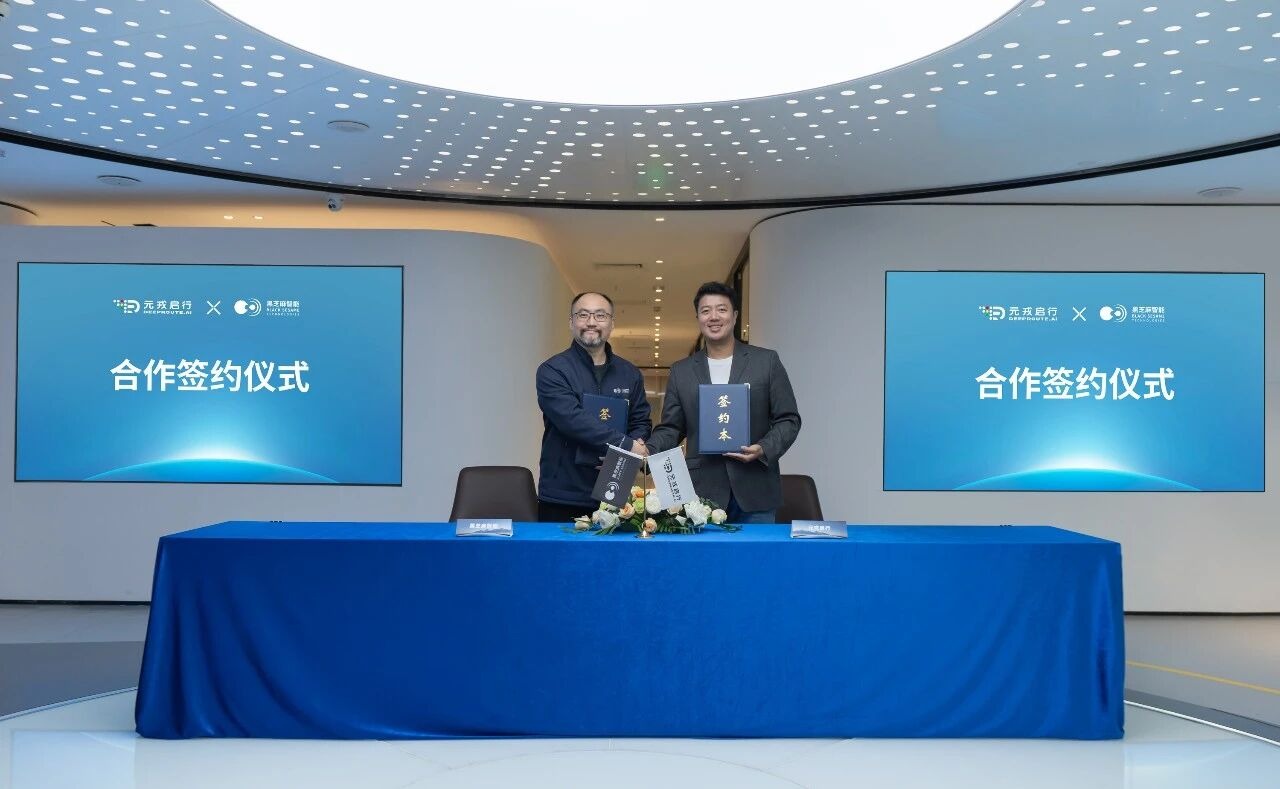
Black Sesame Technologies said on Dec. 12 that it has entered into a strategic partnership with autonomous driving developer DeepRoute.ai, establishing both business and capital ties as the two companies seek to speed up the development and commercialisation of advanced driver-assistance systems (ADAS).
Under the agreement, Black Sesame Technologies will provide its next-generation automotive-grade computing platforms along with a full development toolchain, while DeepRoute.ai will port and optimise its higher-level ADAS algorithms on the chips. The collaboration is intended to create an integrated chip-and-software stack suitable for large-scale deployment in production vehicles.
See also: DeepRoute.ai to Launch Cost-Efficient, Production-Grade Robotaxi Operations by Late 2025
The two companies said they plan to work jointly with major automakers and supply-chain partners to accelerate the mass production of L2+ and L3 driver-assistance systems. In addition to passenger vehicles, they will also explore opportunities in emerging segments such as Robotaxis.
The partnership comes as competition in China’s intelligent-driving sector increasingly shifts toward deeper hardware-software integration and cost efficiency, rather than purely higher performance. Industry participants have said integrated solutions could shorten development cycles and lower system costs for automakers.
Black Sesame Technologies is known for its automotive-grade computing chips, including the Huashan series for driver assistance and the Wudang line for cross-domain processing. The company is preparing to launch its Huashan A2000 chip in 2025, with mass production planned for 2026, targeting next-generation AI models that require significantly higher computing performance and efficiency in complex driving scenarios.
See also: DeepRoute.ai Unveils DeepRoute IO 2.0 With Advanced VLA Technology for Mass-Produced Vehicles
DeepRoute.ai has secured mass-production partnerships with several automakers and has contributed to the launch of more than a dozen vehicle models equipped with combined driver-assistance functions. The company said it has delivered around 200,000 vehicles fitted with its urban navigation-on-autopilot (NOA) system, and in October 2025 accounted for close to 40% of the third-party supplier market in the urban NOA segment.
As China’s ADAS market moves from a performance-driven phase toward cost-optimised, scalable solutions, the partnership is expected to support wider adoption among leading automakers and increase competitive pressure on suppliers that rely heavily on outsourced semiconductor platforms.