
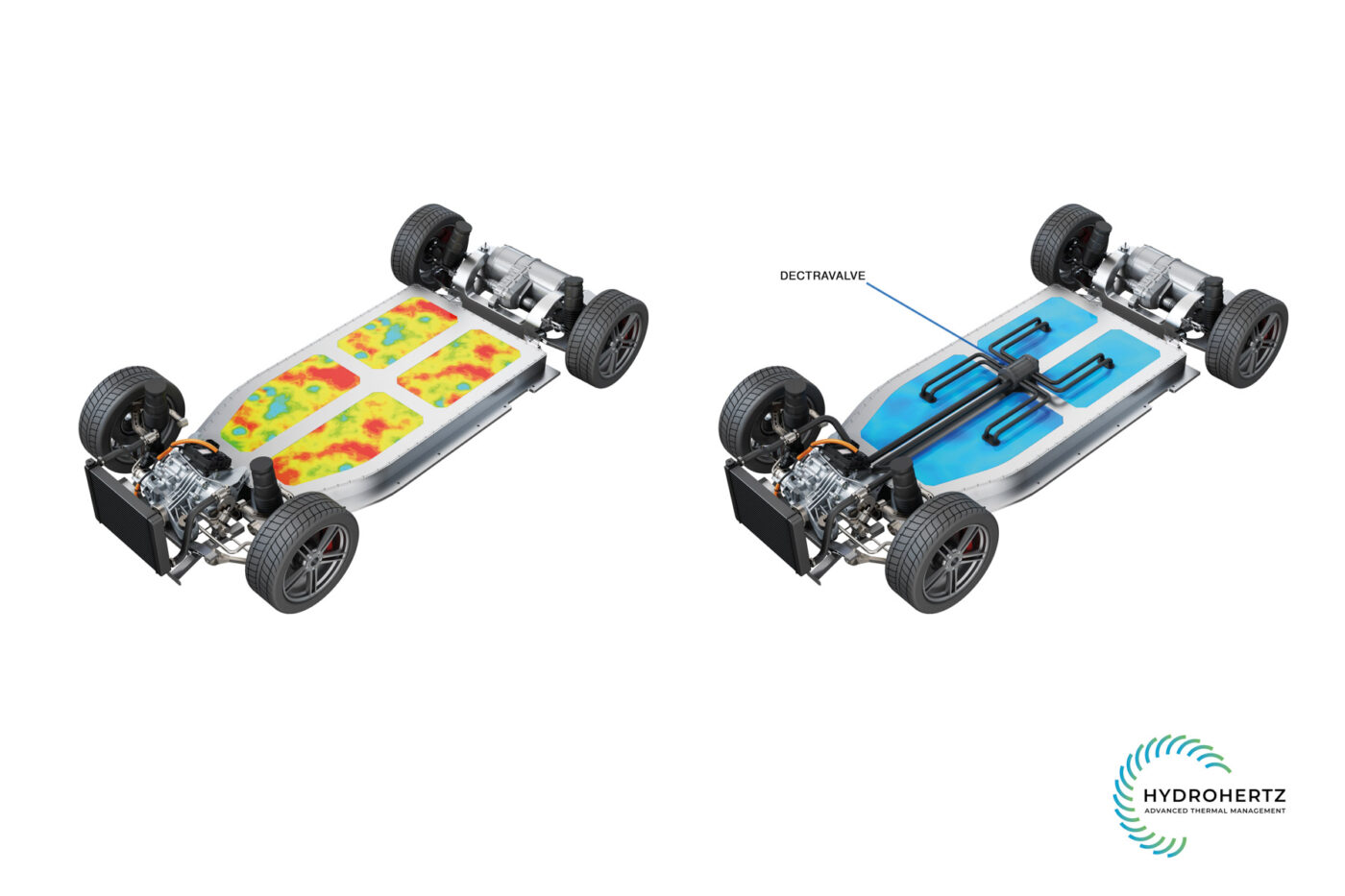
Hydrohertz, a UK-based battery thermal management specialist, has introduced a patented cooling technology designed to shorten electric vehicle fast-charging times while improving range, safety and service life.
The system, known as Dectravalve, is built to manage several independent temperature zones inside a battery pack, a feature the company says marks a significant departure from conventional cooling plates that regulate the pack as a single unit.
See also: EU Confirms Funding for Five Battery Cell Projects After Porsche Unit Withdraws
The compact system is engineered to heat, cool or recover energy with high precision by routing coolant through multiple isolated channels. This contrasts with traditional pack-level cooling, where coolant gradually warms as it circulates, creating temperature differences that engineers must compensate for.
Hydrohertz CTO Martyn Talbot said the product solves “a fundamental problem of EV battery thermal management systems,” adding that it uses “a single, digitally controlled unit that can manage four or more cooling zones separately.”
See also: CATL Begins Mass Production of Fifth-Generation LFP Batteries, Boosting Energy Density and Lifespan
Hydrohertz partnered with independent specialists at the Warwick Manufacturing Group (WMG) to test the technology on a 100 kWh LFP battery at up to 350 kW charging power. According to the company, the system kept the hottest cell below 44.5°C with only a 2.6°C temperature spread across the entire pack.
It reported a charging time of around 10 minutes from 10% to 80%, compared with typical peaks reaching 56°C and temperature differences of up to 12°C in current EVs. Talbot said the design avoids “efficiency-sapping leaks of warm coolant between zones,” enabling more stable fast-charging conditions.
See also: Dongfeng Targets 2026 for Mass Production of 350 Wh/kg Solid-State Batteries
Hydrohertz argues that maintaining tight temperature control can reduce the risk of cell damage, particularly lithium plating, a phenomenon that occurs when temperatures exceed 50°C and forces fast-charging systems to taper early.
CEO Paul Arkesden said the technology offers “consistent 10-minute charging, longer range, extended battery life, and enhanced safety,” adding that it provides performance gains without requiring new battery chemistries. The company estimates that improved operating temperatures could increase real-world range by up to 10%, equivalent to 30–40 miles (48–64 kilometres) in a typical mid-sized EV.