

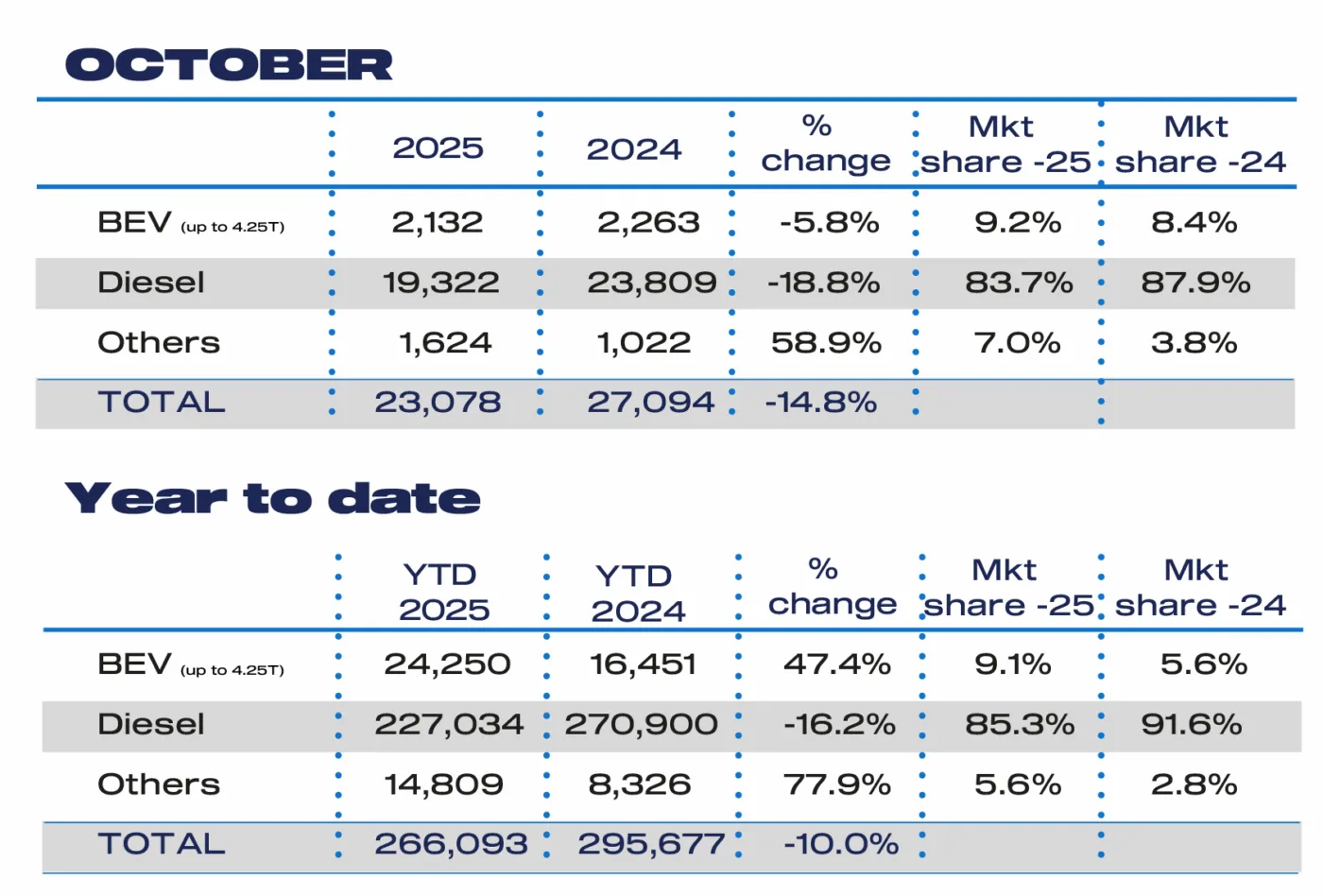
Battery-electric van (BEV) registrations in the United Kingdom fell by 5.8% in October, marking the first monthly drop in 13 months, according to data from the Society of Motor Manufacturers and Traders (SMMT). A total of 2,132 new BEVs were registered during the month, with declines recorded across all van segments.
See also: Survey Shows 75% of UK Van Drivers Now See EVs as Suitable for Business Use
Despite the October setback, the overall market remains strong. Electric van registrations have surged 47.4% so far in 2025, reaching 24,250 units, underscoring growing demand as manufacturers continue expanding their zero-emission model portfolios.
BEVs now account for 9.1% of all new light commercial vehicle (LCV) registrations, up from 8.2% a year ago, though still below the 16% share required under the UK’s 2025 Zero Emission Vehicle (ZEV) mandate.
The SMMT highlighted that while measures such as the Plug-in Van Grant extension, the Depot Charging Scheme, and simplified charger installation reforms are supporting uptake, major infrastructure barriers remain.
Many fleet operators face grid connection delays of up to 15 years, slowing the rollout of depot charging facilities crucial for commercial fleets. The organisation urged the government to fast-track approvals similar to those granted to data centres and wind farms.
See also: UK Extends Plug-In Grant For Electric Vans And Trucks Until 2027
Across the broader market, total LCV registrations fell 15.1% in October to 22,896 units, with year-to-date volumes down 10.3% to 264,160 units. Diesel and petrol vans continue to dominate, but BEVs have held relative strength despite economic headwinds.
SMMT Chief Executive Mike Hawes said that restoring growth in the van market is vital to sustaining investment in zero-emission models. “Every lever must be pulled to get the market back on track, and transitioned at mandated levels. Accelerating infrastructure rollout and grid connections, in particular, will help ensure government targets are not just an aspiration but are actually deliverable for manufacturers and operators alike,” Hawes said.