
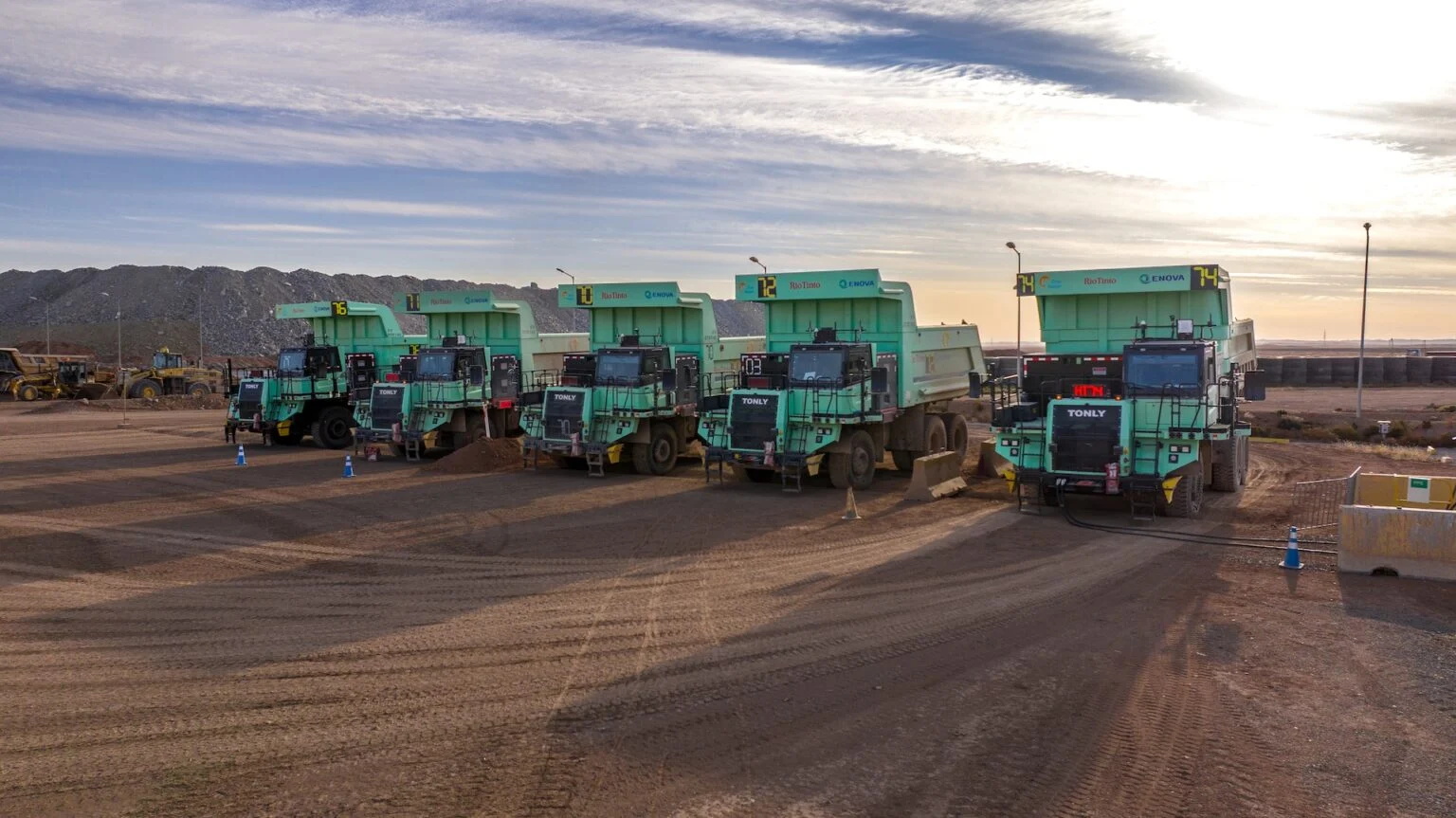
Rio Tinto and China’s State Power Investment Corporation (SPIC) Qiyuan have launched a pilot program to test battery swap electric haul trucks at the Oyu Tolgoi copper mine in Mongolia, marking the first time the mining company has deployed such technology in its surface operations.
The initiative represents a key step in Rio Tinto’s strategy to reduce Scope 1 and 2 emissions from mining haulage, one of its largest carbon sources. The trial introduces a fleet of eight 91-tonne Tonly trucks, each supported by 13 interchangeable 800 kWh batteries, a battery swap station, and a static charging system. The fully integrated setup enables battery exchanges in under seven minutes, significantly cutting downtime and improving vehicle utilization.
See also: Rio Tinto and ENAMI Sign Agreement to Jointly Develop Lithium Project in Chile
The trucks will be used in tailings dam construction and topsoil transport, providing Rio Tinto with operational data to assess real-world performance. The trial, which runs through the end of 2026, is expected to inform future decarbonization strategies across Rio Tinto’s global fleet of 700 haul trucks.
“This trial harnesses China’s leading battery swap technology and shows how partnerships like this can accelerate low-carbon innovation,” said Ben Woffenden, Rio Tinto’s General Manager for Global Equipment and Diesel Transition. “It’s a vital step toward identifying proven, cost-effective solutions that support both operational excellence and decarbonization.”
See also: Chile’s Codelco Taps Rio Tinto for $900 Million Lithium JV in Maricunga
Guo Peng, General Manager of Qiyuan Green Power at SPIC Qiyuan, said, “This milestone trial demonstrates the strength of our battery-swap technology in supporting global mining customers’ low-carbon transitions. We look forward to further collaboration with Rio Tinto to scale these innovations.”
Rio Tinto said the pilot aligns with its broader decarbonization roadmap, which aims to deploy practical low-emission solutions across its global operations. By leveraging proven Chinese electrification systems, the company is exploring scalable technologies to help meet its 2030 carbon reduction targets and accelerate the transition toward cleaner mining logistics.