
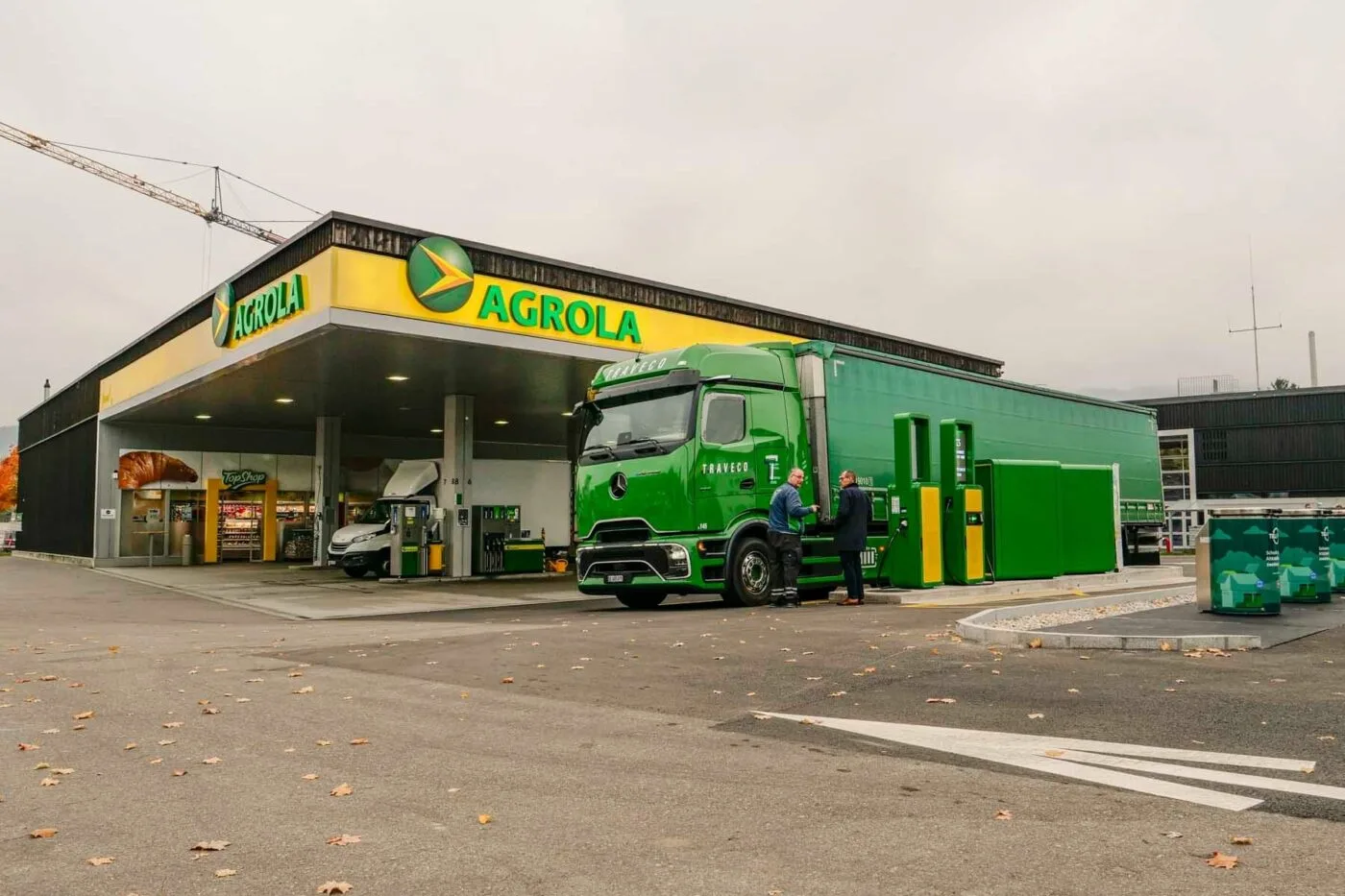
Swiss energy service provider and fuel station operator Agrola has commissioned its first public charging station for electric trucks with a capacity of 600 kilowatts, as part of the conversion of a petrol station in Konolfingen, Bern canton, operated by the Landi Aare cooperative.
The project marks Agrola’s first step into high-capacity truck charging. The new 600 kW charging system, alongside a 400 kW fast-charging station for cars, is integrated into a site powered by a microgrid with solar generation of about 340,000 kilowatt hours per year and energy storage. The total investment of 3.5 million Swiss francs ($4.15 million) was financed by Landi Aare.
See also: Avia Volt Acquires Swiss Charging Operator Plug’n Roll, Expands Network by Over 2,300 Points
Agrola said the Konolfingen site is among the first in Switzerland where electric trucks can charge at up to 600 kW. The high output is enabled by a liquid-cooled cable and plug system. The charging hardware, supplied by Portuguese manufacturer i-charging, includes two 300 kW power units with dynamic load distribution. The facility can be expanded to a total capacity of 1.8 megawatts, accommodating up to four additional charging points.
“By setting up the fast-charging infrastructure for electric trucks, we are providing significant support to the transport and logistics industry in achieving its climate targets,” said Daniel Bischof, Chairman of the Agrola Executive Board. “We are proud to be aligning entire locations with the energy and mobility transition with our innovative and networked solutions.”
Founded in 1957 and based in Winterthur, Agrola AG is a subsidiary of the Fenaco cooperative and operates more than 400 fuel stations across Switzerland. The company has been expanding its services to include renewable energy systems, storage, and electric vehicle charging.
Last year, Fenaco partnered with Swiss Post to form PowerUp, a joint venture to build a nationwide fast-charging network. The venture aims to deploy around 1,500 charging points across 300 locations by 2030, with about 50 sites expected to become operational this year.