
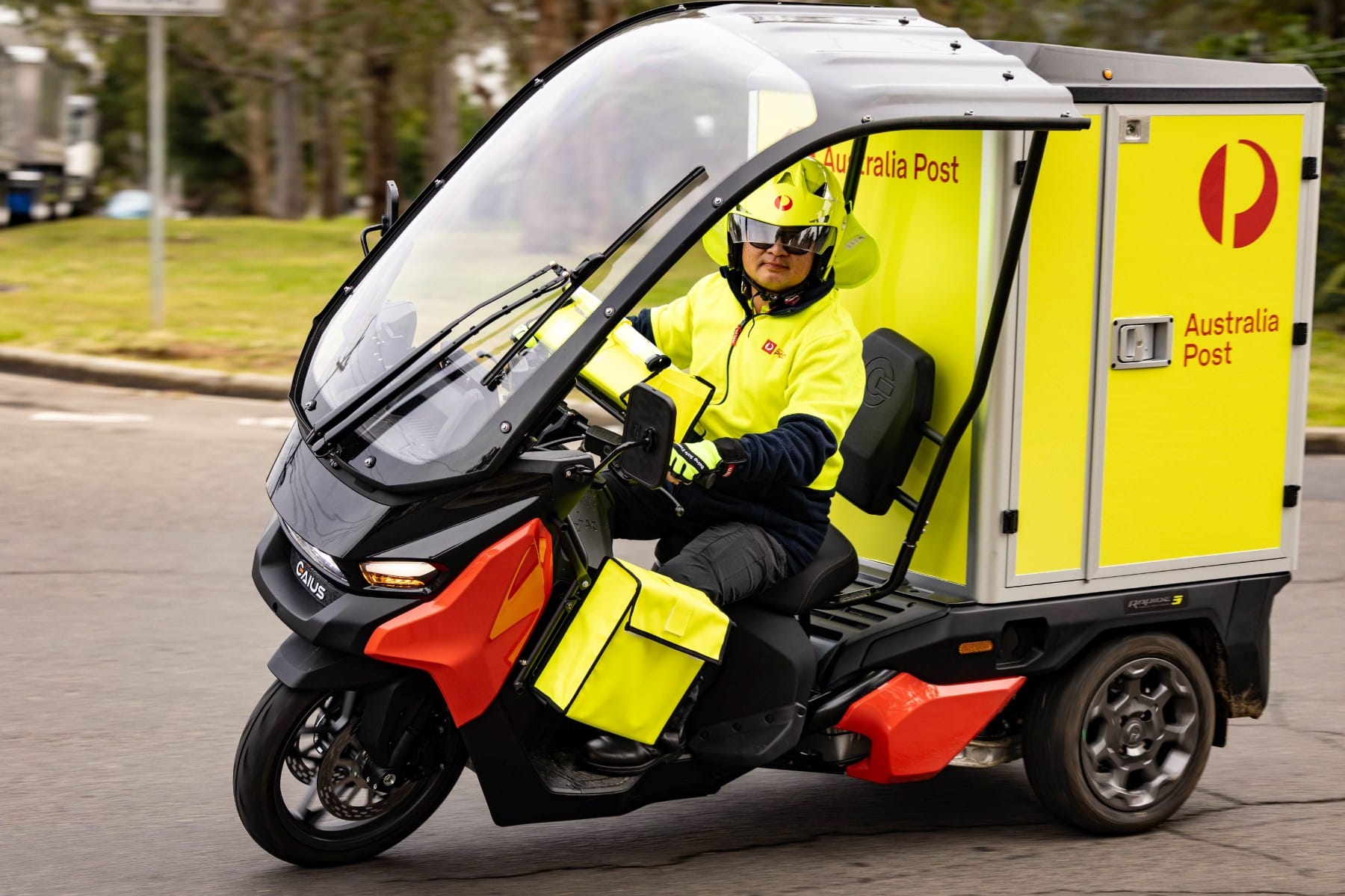
Australia Post has announced the deployment of 500 new three-wheeled electric delivery vehicles, the Rapide 3, as part of its ongoing effort to electrify its national fleet and improve delivery efficiency. The new vehicles will be rolled out across the company’s parcel delivery network in the coming months.
Manufactured by Taiwanese company Gaius Automotive, the Rapide 3 is a purpose-built electric trike designed for logistics operations. It can reach speeds of up to 80 km/h and travel as far as 180 kilometres on a single charge. Each vehicle can carry up to 200 kilograms or approximately 150 small parcels, representing a 400 per cent increase in load capacity compared to the Honda motorbikes previously used by Australia Post.
See also: Australia Post Launches Pilot With 36 Mercedes-Benz eVito Vans in Metropolitan Areas
The Rapide 3 features a patented 35-degree tilting system that enhances stability and maneuverability when turning at higher speeds, even when fully loaded. The models delivered to Australia Post have been customised for Australian conditions, featuring an integrated canopy and windscreen to improve safety and comfort for drivers.
These 500 electric trikes will join Australia Post’s existing fleet of 5,600 electric delivery vehicles, which already includes Fuso eCanter trucks, Mercedes-Benz eVito vans, and DUTY electric motorcycles. The company supports its growing electric fleet with 37 dedicated charging stations nationwide.
See also: RAA Completes South Australia’s Border-to-Border EV Charging Network
Paul Graham, Group CEO and Managing Director of Australia Post, said the addition of the Rapide 3 marks another important milestone in the organisation’s sustainability strategy. “We’ve been investing in electric delivery vehicles for over a decade, and we’re proud to operate Australia’s largest electric delivery vehicle fleet,” he said. “By continuing to invest in an electric fleet, new technology and smarter infrastructure, we’re laying the foundations for a delivery network that can support our communities for decades to come.”