
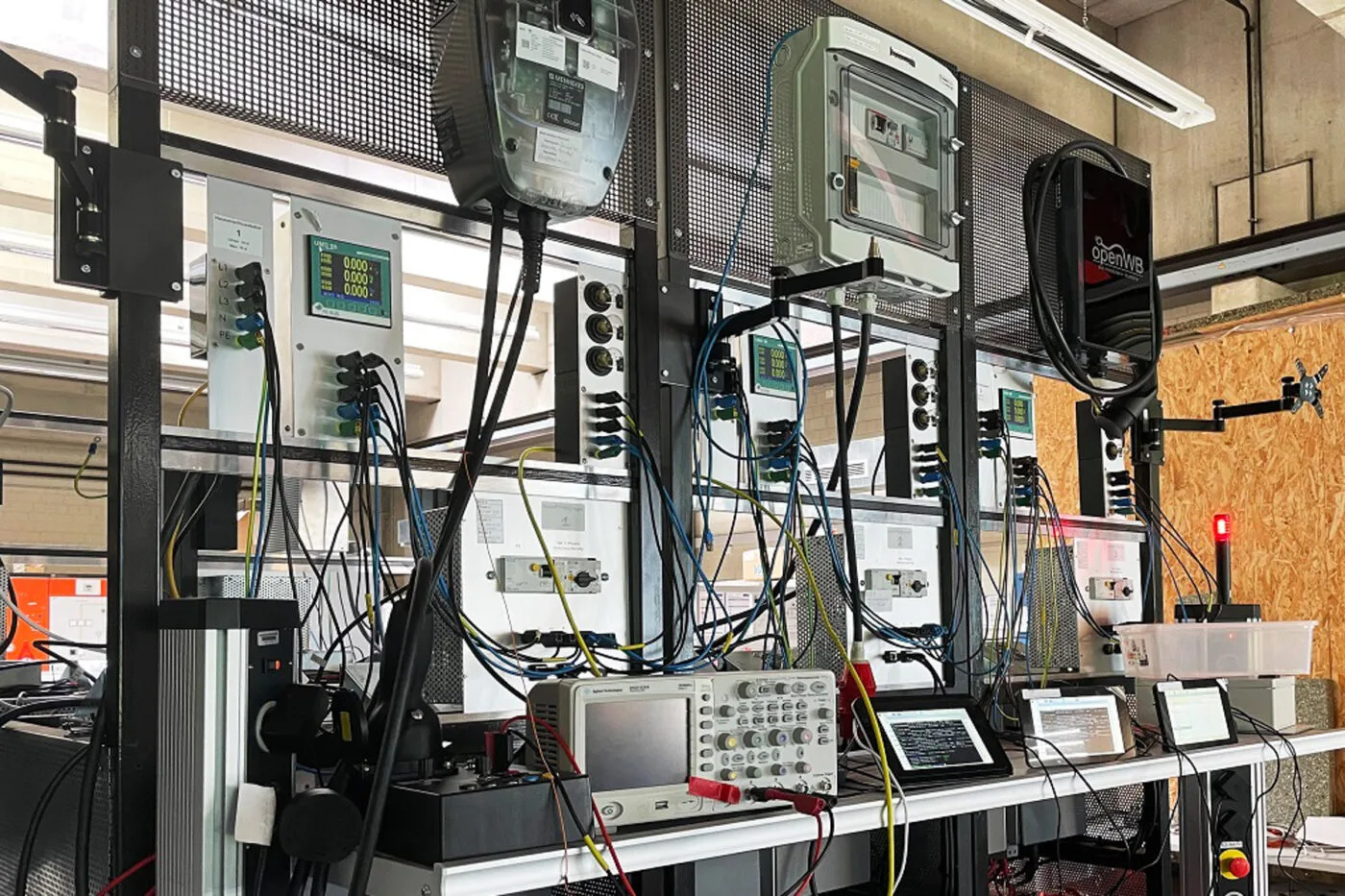
Researchers at Cologne University of Applied Sciences have developed a decentralised system to coordinate electric vehicle (EV) charging across multiple households without requiring expensive grid upgrades or complex infrastructure. The system, developed under the GridMaximiser project, aims to prevent local grid overloads by enabling multiple EVs to charge in coordination based on available capacity.
While the idea that too many EVs charging simultaneously could lead to power outages has been largely disproven by real-world tests, the challenge of managing distributed charging loads remains. Most current load management solutions are localised—suitable for shared spaces like apartment building car parks, but not for detached homes spread across a residential street. The GridMaximiser initiative addresses this gap by proposing a distributed solution that makes full use of existing grid infrastructure.
Project manager Eberhard Waffenschmidt of the Cologne Institute for Renewable Energy (CIRE) said the system is based on the swarm principle. It gathers data from each home’s existing charging station to determine the real-time grid status. This allows charging to be adjusted dynamically to prevent overloading cables or transformers, and to ensure voltages stay within regulated limits.
“Our approach offers a cost-effective alternative to grid expansion or installing expensive measuring equipment in each household,” said Waffenschmidt. “We’re demonstrating how charging processes can be coordinated in a way that supports grid stability without requiring centralised control.”
The system is designed to operate autonomously, without the need for direct coordination with the grid operator. “There’s no need for a central control unit,” added co-project manager Ingo Stadler. “Once installed, the infrastructure manages itself, making planning and implementation much simpler.”
To evaluate the concept, the team built a simulated distribution network in the lab comprising six households, three of which had EV wallboxes. The system allows users to input their required state-of-charge and preferred charging time, while the algorithm calculates when and how much power each vehicle can draw. According to research associate André Ulrich, the algorithm analyses household power usage and grid voltage levels to allocate free capacity without breaching voltage thresholds.
The application has been patented in the United States and is under review in the European Union. Looking ahead, the researchers plan to expand the system to include broader household energy management, such as integrating heat pumps, before moving to field testing with an actual grid operator.