
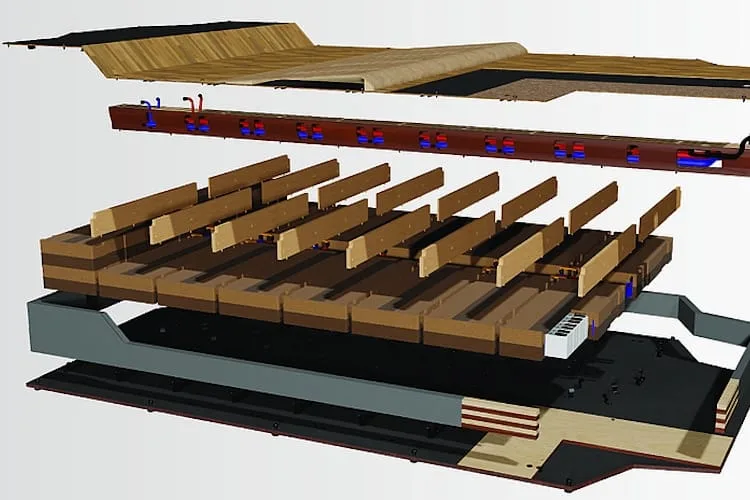
Researchers at Graz University of Technology (TU Graz) have developed a novel battery housing for electric vehicles that replaces conventional aluminium with sustainable materials such as wood, thin sheet steel, and cork. Despite initial skepticism over the use of wood in high-temperature environments, the prototype surpassed a standard Tesla battery housing in fire safety tests.
The innovation is part of the Bio!Lib project, led by TU Graz’s Institute of Vehicle Safety. The new battery housing completely eliminates aluminium, a material widely used for its strength but known for its high energy-intensive production. Instead, the housing relies on a steel shell filled with specially treated wood and cork, offering comparable crash protection and superior fire resistance.
Battery housings are critical for vehicle safety, requiring both structural integrity in a crash and high thermal tolerance during battery fires. In crash testing, the Bio!Lib prototype matched the Tesla Model S’s aluminium housing performance, particularly in the stringent pole impact test.
“When cork is exposed to very high temperatures, it chars,” said Florian Feist, a researcher involved in the project. “Carbonisation leads to a sharp drop in the already relatively low thermal conductivity, which protects the structures behind it.” In fire tests exceeding 1,300 degrees Celsius, the cork-insulated lid kept internal temperatures about 100 degrees Celsius lower than Tesla’s aluminium counterpart.
An environmental assessment conducted in cooperation with the Wegener Centre at the University of Graz found that the Bio!Lib housing offers a more favourable ecological footprint in nearly all categories, including primary energy consumption, emissions, and water use. The only drawback was increased land use due to the sourcing of wood.
Looking ahead, the research team plans to explore using recycled or lower-grade wood and improving cork reuse to enhance the system’s overall sustainability and recyclability. The findings suggest that with appropriate engineering, natural materials can offer a compelling alternative to metal in electric vehicle safety components.