
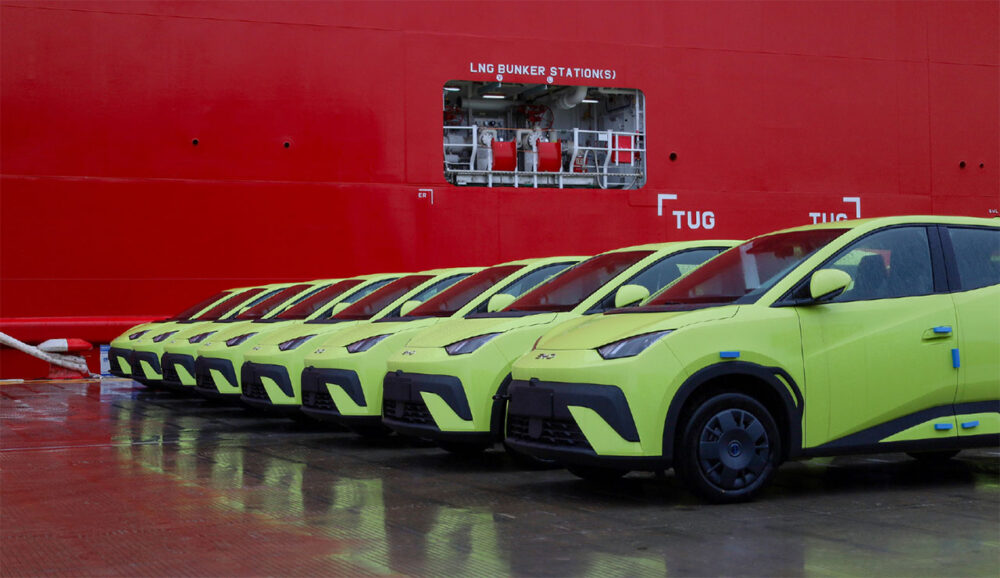
Chinese car brands are continuing their rapid expansion across European markets, with sales in the first half of 2025 surging 91 percent year-on-year to 347,135 units, according to new data from market research firm Jato Dynamics. This brought their market share across 28 European countries to a record 5.1 percent, nearly double the 2.7 percent figure recorded in the same period last year.
The growth puts Chinese brands just behind Mercedes-Benz, which held a 5.2 percent market share in the same period, and ahead of Ford, which accounted for 3.8 percent. The report notes that in June alone, Chinese automakers overtook Mercedes-Benz in monthly sales across the region.
Leading the charge were five brands—BYD, Jaecoo, Omoda, Leapmotor, and Xpeng. Among them, BYD saw the strongest performance, with registrations rising 311 percent year-on-year to 70,500 units in the first half. In June alone, BYD registered 15,565 vehicles, placing it among the top 25 best-selling brands in Europe—above Suzuki, Mini, and Jeep.
The BYD Seal U tied with the Volkswagen Tiguan as the top-selling plug-in hybrid electric vehicle (PHEV) in Europe for June, and ranked third in PHEV sales for the first half overall. Meanwhile, Jaecoo and Omoda—both sub-brands of Chery—also saw rapid growth, largely driven by internal combustion and hybrid SUVs rather than fully electric models. In June, PHEVs accounted for 29 percent of their European sales, while combustion-powered models made up 63 percent.
Leapmotor registered more than 8,300 vehicles in Europe in June alone, driven by demand for its compact T03 sedan and the C10 SUV. Xpeng emerged as the top-performing Chinese premium brand in Europe so far in 2025, with 8,338 registrations in the first half—mostly attributed to the G6 SUV, which accounted for 5,615 units.
In contrast, several legacy automakers saw declines. Stellantis’ market share dropped from 16.7 percent to 15.3 percent year-on-year, while Tesla’s share fell from 2.4 percent to 1.6 percent. SAIC overtook Tesla for the first time in Europe, with sales rising 22 percent to 162,153 units compared to Tesla’s 33 percent drop to 109,264 units in the same period.
The data highlights the growing influence of Chinese automakers in Europe’s competitive automotive landscape, driven by aggressive pricing, expanding product lineups, and a mix of hybrid and electric offerings tailored to regional preferences.