
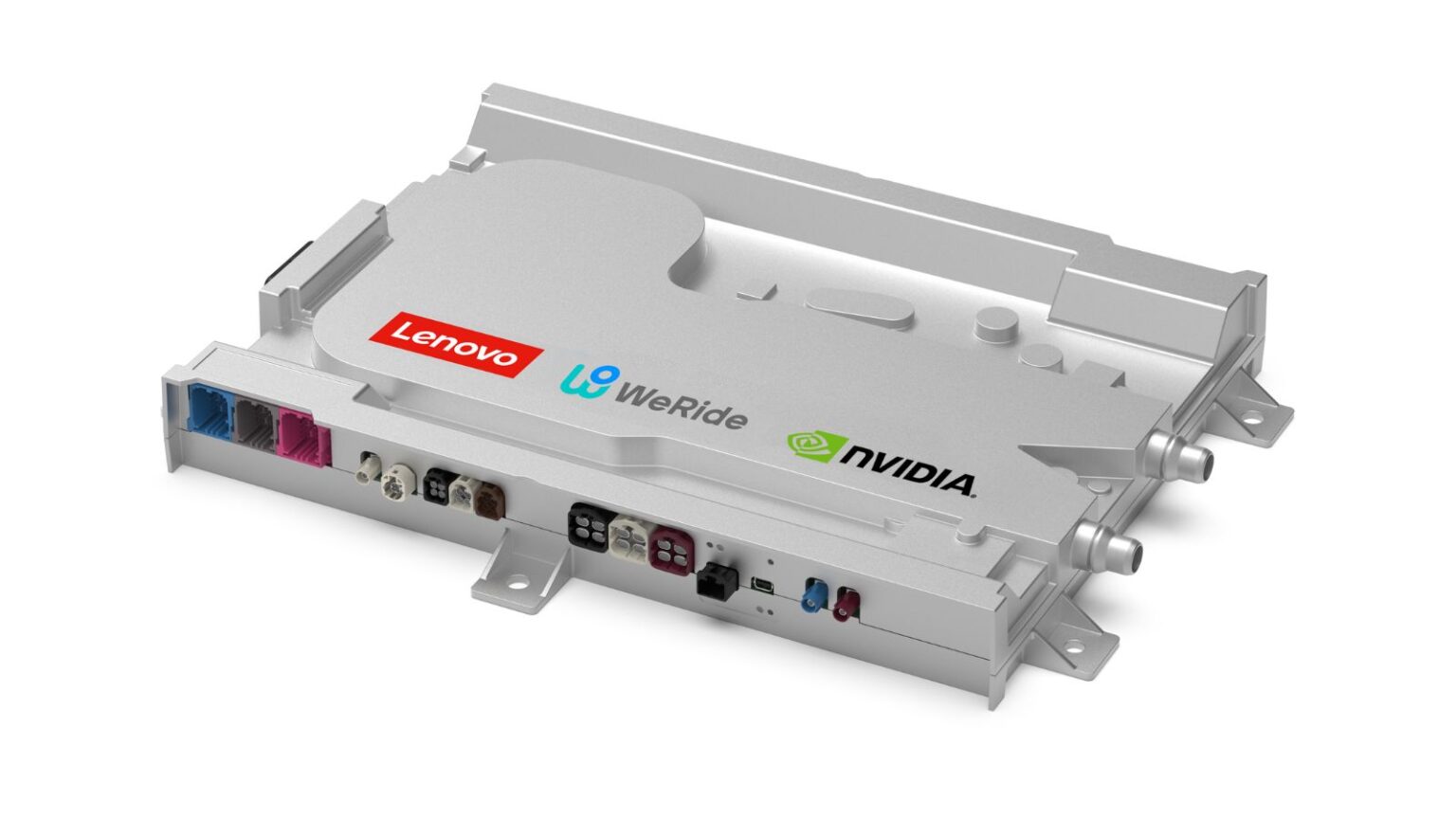
Autonomous driving technology company WeRide has introduced a new high-performance computing platform, HPC 3.0, developed in collaboration with Lenovo and NVIDIA. The platform is designed to support Level 4 autonomous vehicles and will be used in WeRide’s latest Robotaxi model, the GXR.
The HPC 3.0 system is powered by two NVIDIA DRIVE AGX Thor chips and integrated with Lenovo’s AD1 L4 domain controller. It provides up to 2,000 TOPS of AI computing capacity and combines key modules such as Ethernet and CAN gateways, inertial navigation, and collision detection. According to WeRide, the new platform lowers the cost of the autonomous driving suite by 50% and reduces production costs by 75% compared to its predecessor.
Built for durability and global application, the platform is certified to automotive safety standards including AEC-Q100, ISO 26262, and IATF 16949, and is rated at the ASIL-D safety level. It is designed to function in temperatures ranging from -40°C to 85°C, with a failure rate of fewer than 50 FIT and a mean time between failures of up to 180,000 hours. The system is intended to support a service life of 10 years or 300,000 kilometers and is compliant with international environmental requirements.
WeRide’s partnership with Lenovo and NVIDIA supports the development of computing infrastructure capable of handling advanced workloads such as generative AI and vision-language models. The HPC 3.0 platform will initially be deployed in the Robotaxi GXR and is also planned for future integration into other vehicle models, including the company’s Robobus and Robosweeper.
WeRide currently operates in more than 30 cities across 10 countries, including China, the United States, the United Arab Emirates, Singapore, and France. The launch of HPC 3.0 is part of the company’s ongoing efforts to expand its autonomous driving portfolio and support wider deployment of Level 4 vehicles.