
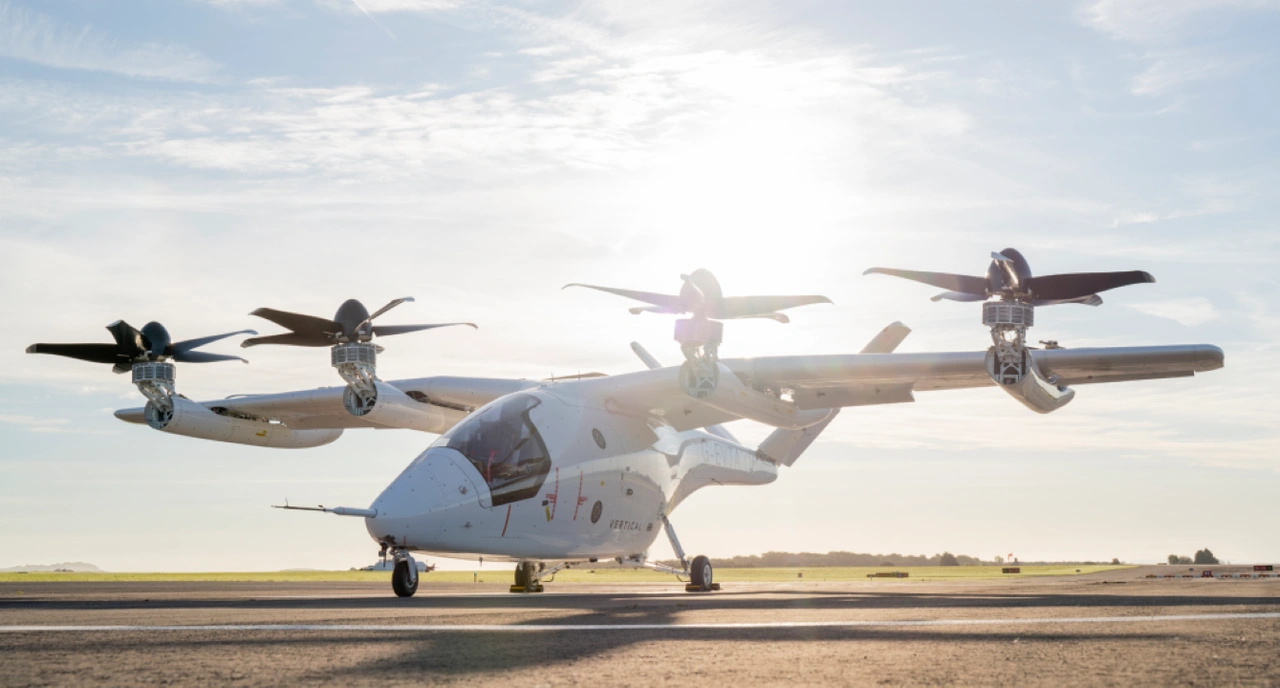
British air taxi developer Vertical Aerospace has filed for a $60 million stock offering to support research and development of its VX4 electric vertical takeoff and landing (eVTOL) aircraft, as the company moves forward with piloted testing and expands plans for a hybrid-electric variant.
The offering includes a 30-day option for underwriters to purchase an additional $9 million in shares, the company said. Proceeds are expected to be used for continued R&D, including further flight testing of the VX4 prototype and development of future vehicle configurations.
Vertical’s VX4 is a four-passenger eVTOL designed for short-range urban air mobility. The company recently completed its first piloted wingborne flight at Cotswold Airport in the United Kingdom, marking a milestone in demonstrating controlled flight under real-world conditions. The flight was approved by the UK Civil Aviation Authority (CAA) under an extended permit to fly.
Vertical has reported over 1,500 conditional pre-orders for the VX4 from major operators including American Airlines, Japan Airlines, GOL, and Bristow. The agreement with Bristow, recently expanded, includes an initial pre-order for 50 aircraft with an option for 50 more, and aims to offer a turnkey model providing aircraft, pilots, maintenance, and insurance services.
As part of its product roadmap, Vertical is also developing a hybrid-electric variant with a range of up to 1,000 miles and payload capacity exceeding 2,000 pounds. The hybrid propulsion system has been under development for 18 months and is expected to be retrofitted into a VX4 prototype for flight testing in 2026. The initial configuration will utilize a gas turbine generator operating on conventional jet fuels.
Vertical’s strategic partners include aerospace suppliers such as Honeywell, GKN Aerospace, Leonardo, Molicel, Hanwha, Volz Servos, and Syensqo. The company is also working on proprietary energy storage and control technologies for future models.
The VX4 has completed over 30 piloted test flights, including hover, low-speed maneuvers, and performance validation. The next phase of certification will involve transition testing to demonstrate the aircraft’s ability to shift between vertical lift and forward flight.