
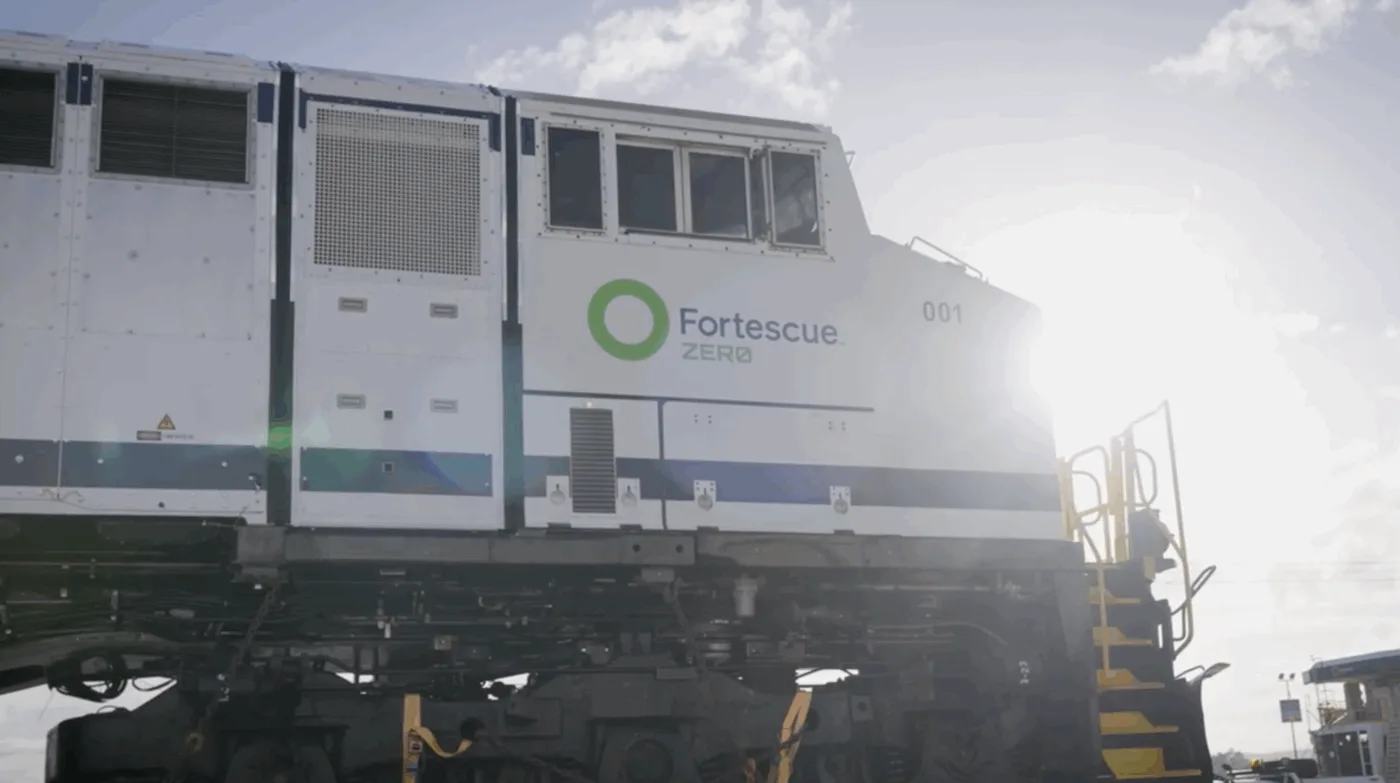
Australian mining company Fortescue has presented the prototype of its ‘Infinity Train,’ a self-charging electric locomotive that uses regenerative braking to power its return journey, a key step in the company’s broader decarbonisation strategy.
The train, which operates in the Pilbara region of Western Australia, is designed to transport iron ore downhill to port terminals while harvesting energy through braking systems. The captured energy is stored in onboard batteries, which then power the empty train on its uphill return to the mine — eliminating the need for external charging or fossil fuels.
First announced in 2022 following Fortescue’s acquisition of UK-based Williams Advanced Engineering (WAE), the Infinity Train is part of the company’s target to achieve net-zero operational emissions by 2030. Fortescue has already developed battery-powered 400-tonne haul trucks and heavy industrial equipment as part of the same initiative.
“The Infinity Train will not only accelerate Fortescue’s race to reach net zero emissions by 2030, but also lower our operating costs, create maintenance efficiencies and productivity opportunities,” said Dr Andrew Forrest AO, Fortescue’s Founder and Chairman.
Fortescue’s private railway, stretching 1,100 km across the remote Pilbara, was originally constructed in 2008 to support its iron ore export business and is among the world’s most robust freight lines, built to handle 40-tonne axle loads. With the Infinity Train, Fortescue is now leveraging the same infrastructure to test large-scale regenerative transport in one of the world’s most logistically challenging environments.
Initial modelling shows that some of Fortescue’s routes possess sufficient gradient to make the self-charging mechanism viable, further reducing energy input and emissions. While full deployment timelines have not been confirmed, the prototype marks a significant advancement in zero-emission rail transport.