
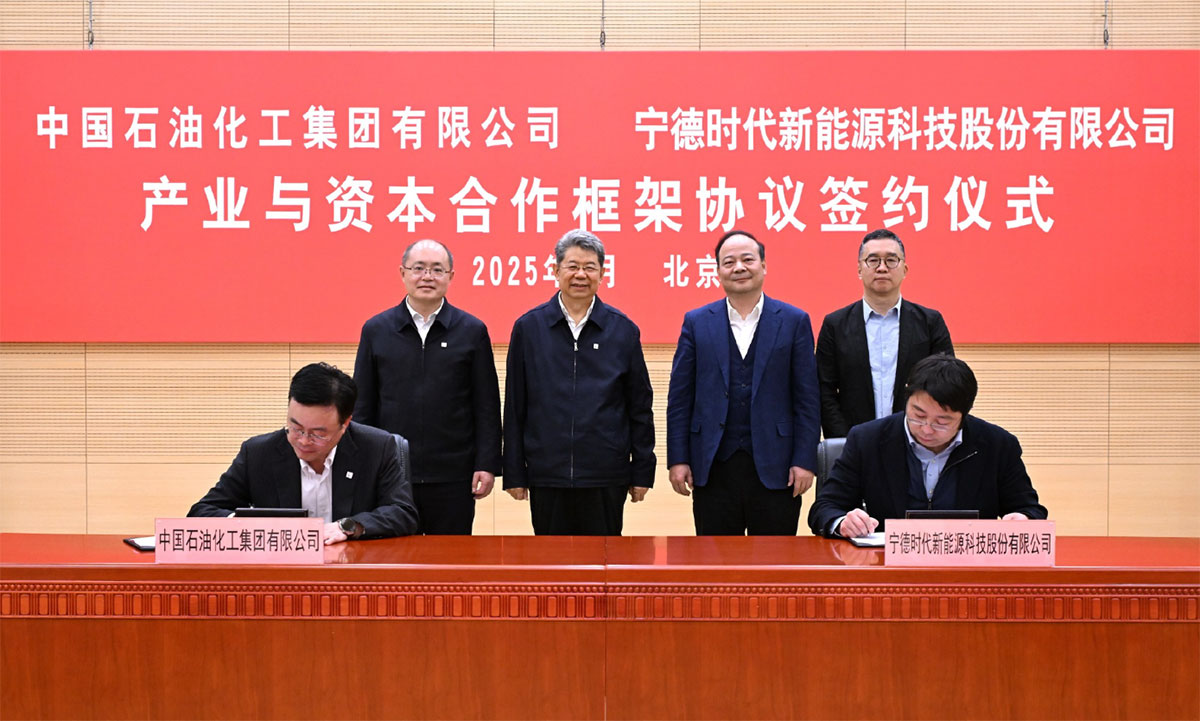
Chinese battery giant CATL has signed a strategic partnership with state-owned fossil fuel company Sinopec Group to accelerate the development of a nationwide battery swap network, the companies announced today.
Under the agreement, CATL and Sinopec will build at least 500 battery swap stations this year, with a long-term goal of reaching 10,000, according to a press release from CATL. The collaboration aims to leverage CATL’s expertise in battery technology and swap systems alongside Sinopec’s extensive network of fuel stations and infrastructure.
See also: CATL Secures Approval for Hong Kong Share Sale, Eyes $5 Billion Fundraising
“We hope to make battery swapping as convenient as refueling through this partnership, a mission and vision shared by battery swap players,” said Yang Jun, general manager of CATL’s battery swap business.
The signing was attended by CATL Chairman and CEO Robin Zeng and Sinopec Chairman Ma Yongsheng. The companies will jointly deploy battery swap solutions for both passenger vehicles and heavy-duty trucks, utilizing CATL’s Choco-Swap and Qiji Energy platforms.
See also: CATL Advances Sodium-Ion Battery Technology, Nearing LFP Energy Density
CATL entered the battery swap market in January 2022 and has since launched several battery swap-enabled models in partnership with major automakers. The company’s Choco-Swap solution standardizes passenger car batteries, with its Choco-SEB packs categorized similarly to fuel grades in China.
For heavy trucks, CATL’s Qiji Energy system, unveiled in June 2023, has been integrated into more than 30 models, offering a cost-efficient alternative to traditional refueling.
See also: Nio, CATL Sign Strategic Deal to Boost Battery Swap Services
Sinopec, traditionally focused on fossil fuels, has been expanding its role in the electric vehicle infrastructure sector. In 2021, the company signed a strategic partnership with Nio (NYSE: NIO) to develop charging and battery swap stations. By April 2023, that collaboration had resulted in 102 battery swap stations, 121 supercharging stations, and 28 destination charging sites.