
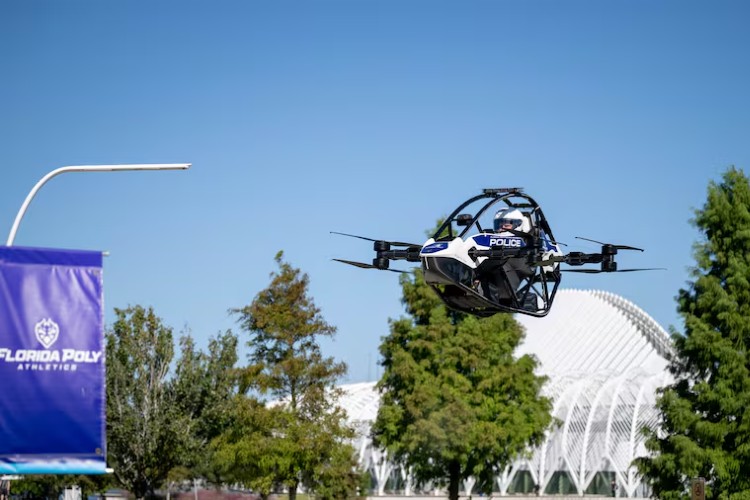
Florida Polytechnic University’s Police Department is preparing to use a manned electric vertical take-off and landing (eVTOL) aircraft for law enforcement operations, becoming the first police agency in the United States to integrate this type of aircraft into its service.
The aircraft, named Astro, is a single-seat Jetson ONE developed by US manufacturer Jetson. According to the university, it is in the final stages of the approval process with the Federal Aviation Administration (FAA) for the intended operational use.
eVTOL planned for patrol and emergency response
Florida Polytechnic University expects Astro to support campus patrols and monitoring of surrounding areas. The aircraft could also provide access to locations that are difficult to reach using conventional vehicles, assist with post-storm clean-up operations and transport emergency supplies when required.
The university’s police department also plans to work with law enforcement agencies across the region to explore the aircraft’s use in emergency response and other public safety activities.
“Advanced air mobility is a technology on the rise, and we can either choose to be proactive or reactive as it develops,” said Aaron Murray, the University’s police chief. “We want to stay at the forefront of this technology and understand how it can be used to advance public safety and airspace safety altogether.”
Jetson ONE specifications
Astro is based on the Jetson ONE, a compact, single-seat electric aircraft designed for vertical take-off and landing. According to the manufacturer’s specifications, the aircraft measures 2.7 metres long, 1.6 metres wide and 1.22 metres high. Its wings can be folded to reduce its dimensions for storage and transport.
Jetson lists the aircraft’s total weight, including its lithium-ion batteries, at 115 kilograms. The battery system provides an estimated flight time of approximately 20 minutes, while the aircraft has a stated maximum speed of 102 km/h.
The manufacturer has not disclosed further details about the propulsion system or battery configuration.
Jetson CEO Stéphan D’haene said the company prioritised Florida Polytechnic University’s order despite a reported three-year waiting list. He cited the university’s focus on science, technology, engineering and mathematics (STEM), alongside its police department’s public safety objectives.
“In our business plan and in alignment with our mission, we have always been looking for the use case beyond the recreational intent,” D’haene said. “We believe that this project is so important and aligns so much with what we want to do that we made it a priority.”
Aircraft to support university research
Beyond its planned police applications, Astro is also intended to provide students and faculty with a practical platform for learning and research into emerging aviation technologies.
The university introduced a new Aerospace Engineering degree programme this autumn, offering students opportunities to study advanced aircraft and flight technologies through hands-on activities.
Florida advances advanced air mobility testing
Florida is also participating in the FAA’s eVTOL and Advanced Air Mobility Integration Pilot Program, which aims to support the integration of next-generation aircraft into the US national airspace.
Florida Polytechnic University is located approximately four miles from SunTrax, a dedicated testing facility in Auburndale operated by the Florida Department of Transportation. Initial eVTOL testing at the site is scheduled to begin by the end of this year.
The university’s planned deployment of Astro would place its police department among the early public-sector adopters of crewed electric aircraft, although operational use remains subject to the required FAA approval.