
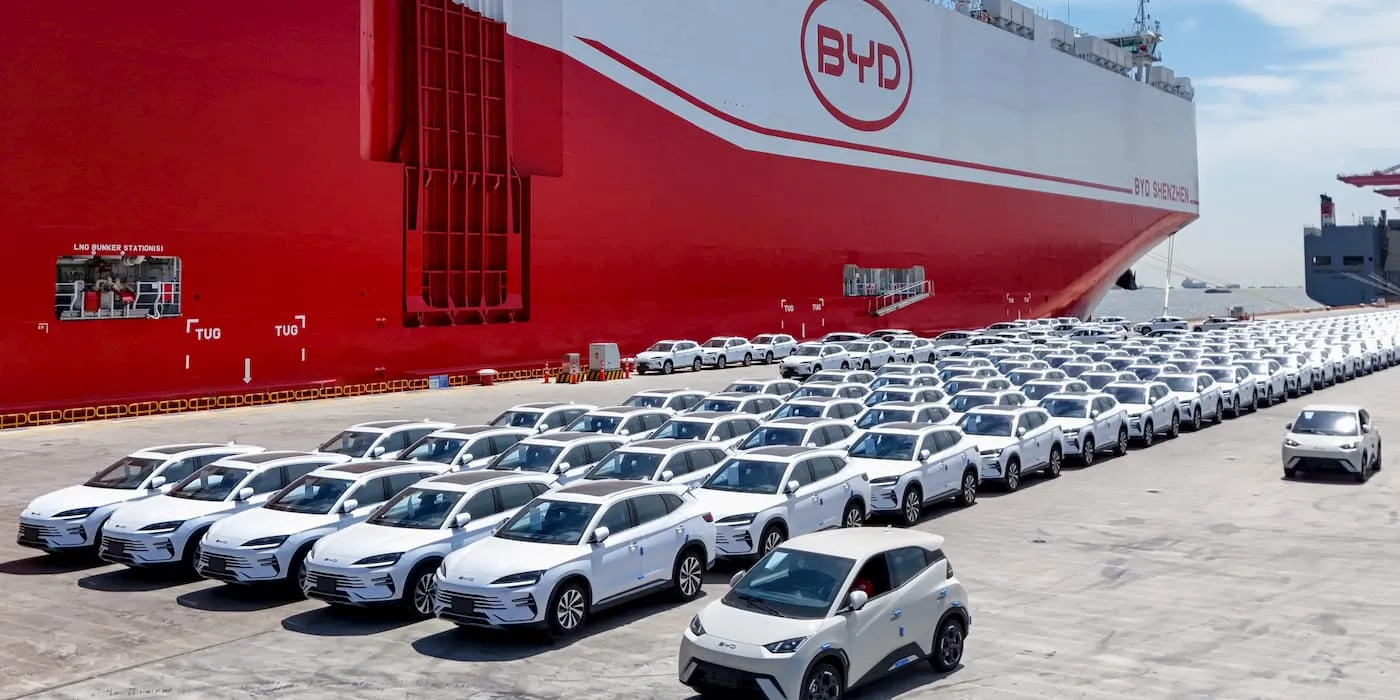
Chinese automakers have outsold Japanese brands in Europe’s passenger car market for the first time, highlighting the growing influence of Chinese electric vehicle manufacturers despite European Union tariffs of up to 45.3% on Chinese-made battery-electric vehicles.
According to data from the European Automobile Manufacturers’ Association (ACEA), five major Chinese brands—BYD, SAIC, Geely, Chery and Leapmotor—sold a combined 138,410 vehicles across 31 European markets in May, an increase of 65% compared with a year earlier.
By comparison, Japanese manufacturers Toyota, Honda, Nissan, Suzuki, Mazda and Mitsubishi collectively sold 130,424 vehicles, representing a 3% decline year over year.
Chinese EV Makers Continue Rapid Expansion
The latest milestone reflects sustained momentum rather than a one-off monthly result.
SAIC has recorded year-over-year sales growth in 17 of the past 24 months, while BYD has posted sales growth in every month since the company was added to ACEA’s reporting in July 2025.
BYD has become the main driver of Chinese growth in Europe. During the first half of 2026, the automaker’s overseas passenger vehicle sales increased 70% to 789,367 units.
Chairman Wang Chuanfu recently told shareholders the company expects overseas deliveries to reach 1.6 million vehicles this year, more than 50% above 2025 levels.
The overseas expansion comes as BYD reported its first first-half decline in domestic vehicle sales in six years.
Tariffs Fail to Slow Sales Momentum
Although the European Union introduced additional tariffs on Chinese-built battery-electric vehicles, Chinese manufacturers have largely maintained their price competitiveness.
For example, BYD’s Dolphin Surf Boost starts at €26,990 in Europe, remaining slightly cheaper than comparable European electric models.
Chinese manufacturers have also expanded their focus on plug-in hybrid electric vehicles (PHEVs), which are not subject to the additional EU tariffs.
Sales of Chinese plug-in hybrids increased 140% year over year in May, providing another avenue for market growth.
Electrification Widens Competitive Gap
Government incentives introduced across Europe have further strengthened demand for electrified vehicles.
Germany now offers incentives of up to €6,000 for qualifying battery-electric and plug-in hybrid vehicles, while Sweden and Italy have also expanded support programs.
Japanese manufacturers remain competitive in conventional hybrid vehicles but currently offer relatively limited battery-electric and plug-in hybrid model ranges compared with Chinese rivals.
During the first quarter of 2026, electrified vehicles accounted for 67.5% of all new passenger vehicle sales in Europe, with battery-electric vehicles representing 19.5% of the market.
Chinese Manufacturing Expands Into Europe
Chinese automakers are also increasing their manufacturing presence within Europe to reduce exposure to import tariffs.
Leapmotor plans to assemble sport utility vehicles at a Stellantis factory in Spain, while Chery established its European headquarters in Barcelona earlier this year.
Reports also indicate Nissan is discussing manufacturing cooperation with Chery at its Sunderland facility in the United Kingdom, and BYD is expected to acquire a former Stellantis industrial site in Southern Europe to expand local production.
The growing investment in European manufacturing suggests Chinese automakers are pursuing a long-term strategy that combines competitive electrified vehicle portfolios with localized production to strengthen their position in one of the world’s largest automotive markets.