
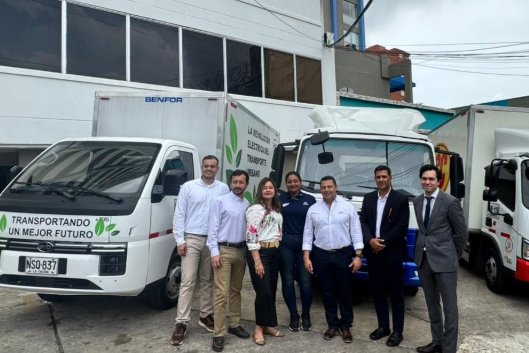
Colombia has unveiled plans to establish its first zero-emission freight transport corridor for electric trucks through a new initiative known as Ruta-E, as the country seeks to accelerate the decarbonization of its logistics sector.
The project will connect Bogotá with the Caribbean port city of Cartagena, passing through Barranquilla, and is designed to support the deployment of electric heavy-duty vehicles by providing dedicated charging infrastructure along the route.
Public and Private Sectors Join Forces
The Ruta-E: Clean Energy in Motion initiative is being developed through a partnership between Colombia’s Ministry of Transport, clean transportation organization CALSTART, and a group of logistics, automotive, and energy companies.
Project participants include DHL, BYD, Auteco Blue, TCC, and Voltrelli, among others.
The collaboration aims to address one of the main barriers to electric truck adoption in Latin America: the availability of reliable charging infrastructure for long-distance freight operations.
Charging Network Planned Along Key Logistics Route
Under the proposal, charging stations for electric trucks will be installed at intervals of no more than 100 kilometers along the 1,195-kilometer corridor.
The route links Colombia’s capital with one of the country’s largest port regions, creating a strategic freight connection between inland industrial centers and Caribbean trade gateways.
Project developers said the infrastructure will help facilitate the transition from diesel-powered freight transport to battery-electric trucks while encouraging additional investment in charging networks.
Government Targets Freight Sector Decarbonization
Colombia has identified transportation as a key sector in its broader climate and energy transition strategy.
Officials estimate that widespread adoption of electric trucks along the corridor could reduce carbon dioxide emissions by more than 185,000 tonnes annually by 2032, equivalent to removing approximately 40,000 passenger vehicles’ worth of emissions from the road each year.
Transport Minister María Fernanda Rojas Mantilla said the country intends to build on its progress in electric passenger vehicles.
“Colombia is already a regional leader in electric passenger vehicles, and we are going to achieve the same with trucks.”
“The technology is ready, the economic benefits keep growing, and these industry leaders are telling us they want to adopt electric trucks and that they want to manufacture them.”
More Than 1,000 Electric Trucks Expected
Project partners estimate that more than 1,000 electric trucks could be operating along the corridor by 2032.
While detailed information regarding charging station specifications and vehicle deployment plans has not yet been released, the initiative is expected to support both fleet operators and vehicle manufacturers seeking to expand electric freight transportation in Colombia.
The government is also supporting electric vehicle adoption through tax incentives and programs aimed at expanding charging infrastructure nationwide.
Model for Future Freight Corridors
The Ruta-E project is intended to serve as a blueprint for additional zero-emission freight corridors across Colombia.
As logistics companies face increasing pressure to reduce emissions, governments and industry groups are exploring ways to electrify heavy-duty transport while maintaining operational efficiency.
By combining charging infrastructure development with fleet deployment, Colombian authorities hope the corridor will demonstrate the commercial viability of electric freight transport on long-distance routes.
The initiative positions Colombia among a growing number of countries seeking to accelerate the electrification of commercial transportation and reduce emissions from one of the most challenging segments of the transport sector.
Source: globaldrivetozero.org