
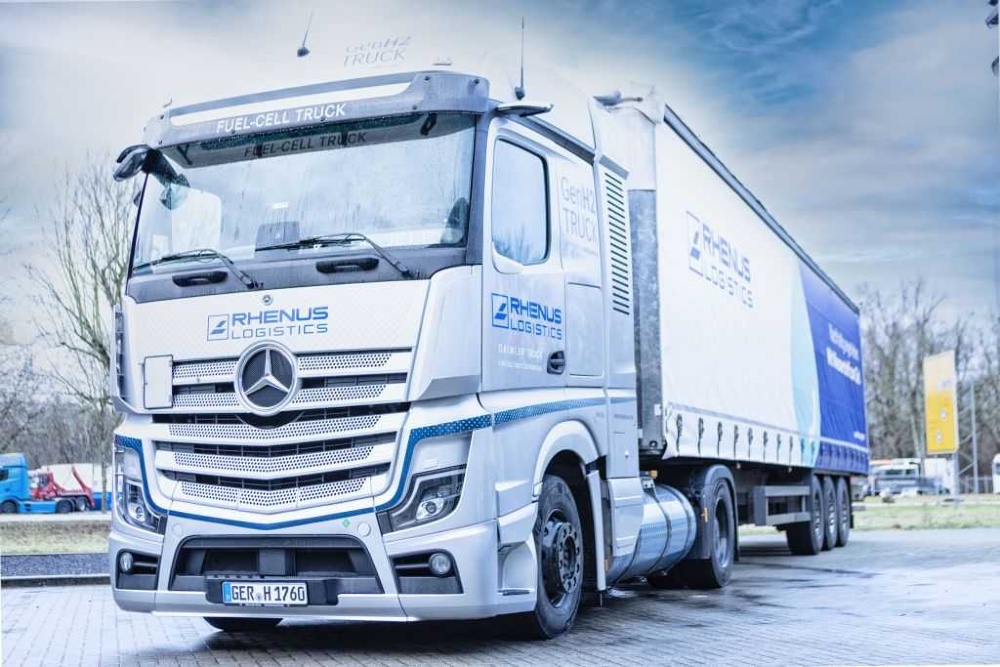
Rhenus Group has begun testing a hydrogen-powered truck from Daimler Truck as part of a one-year customer trial of the Mercedes-Benz GenH2 Truck, marking the second phase of real-world validation for the technology.
The pre-series vehicle, powered by liquid hydrogen, is based at Rhenus’ logistics hub in Duisburg and has been fully integrated into daily operations. According to the company, the truck is used five days a week across both regional and long-haul routes, covering distances ranging from around 150 kilometres to up to 650 kilometres.
The trial forms part of a broader programme involving five logistics and industrial partners, including DHL Supply Chain, Hornbach, Reber Logistik and Teva Pharmaceutical Industries. Each participant operates one vehicle under real transport conditions in Germany.
“Thanks to high utilisation and diverse transport profiles, the truck achieves exceptionally high daily mileage,” Rhenus said, highlighting the intensity of its testing programme.
The focus of the trial is on evaluating operational performance, including refuelling processes, range and turnaround times compared with conventional diesel trucks. Duisburg was selected as a test location due to its role as a central logistics hub and its access to hydrogen refuelling infrastructure.
However, infrastructure remains a key limitation. Currently, only two filling stations in Germany—located in Duisburg and Wörth am Rhein—can supply the liquid hydrogen (sLH2) required for the GenH2 Truck, with industrial gas company Linde acting as a partner.
Daimler Truck said the expansion of hydrogen refuelling infrastructure has been slower than expected, which could limit near-term adoption. “However, the expansion of hydrogen refueling infrastructure is progressing significantly slower than expected. As a result, customers will not be able to deploy hydrogen trucks in large numbers in the next few years,” the company stated.
The GenH2 Truck is powered by dual fuel cell systems supplied by Cellcentric, delivering a combined output of 300 kW, supported by a 70 kWh battery that provides additional power during peak demand. The vehicle is designed for a gross weight of around 40 tonnes and a payload of approximately 25 tonnes.
Using liquid hydrogen enables a range of more than 1,000 kilometres, making the technology particularly suited to long-haul transport. Daimler Truck previously demonstrated this capability with a prototype covering over 1,000 kilometres on a single tank.
“As part of a small-series production, a total of 100 tractor units are to be built at the Mercedes-Benz plant in Woerth and put into customer operations starting at the end of 2026,” Daimler Truck said, although full-scale production has been postponed to the early 2030s amid cost pressures and infrastructure challenges.
“Particularly in energy-intensive heavy-duty and long-haul transport, we see significant potential in hydrogen-powered trucks,” said Thilo Meutzner, Managing Director of Rhenus Road Freight in Germany. “The field test helps us realistically assess the conditions under which this technology could be adopted on a broader scale in the future.”