
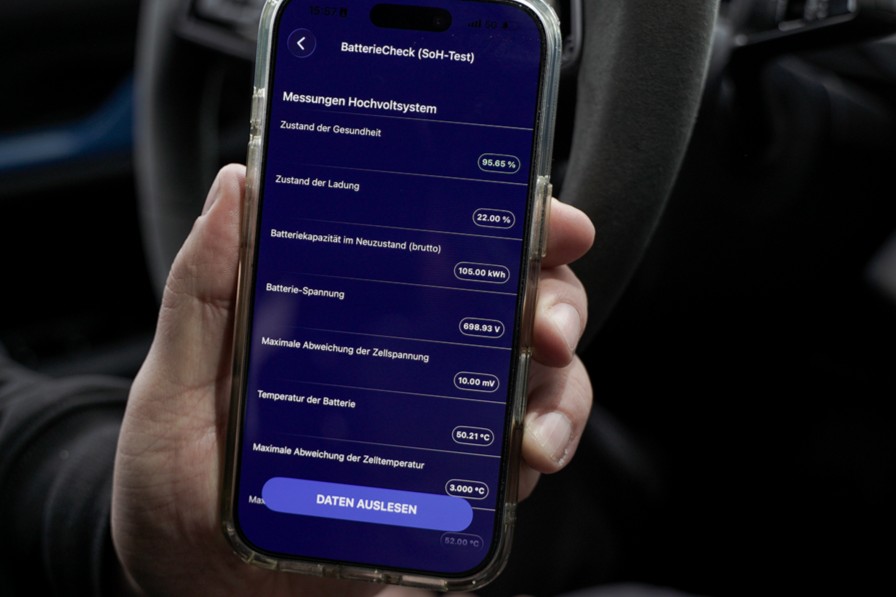
An analysis of around 50,000 electric vehicles and plug-in hybrids by TÜV Nord and Carly shows that battery health in most vehicles is stronger than expected, though degradation accelerates significantly at higher mileage.
The study found a median State of Health (SoH) of 96% across vehicles built between 2016 and 2026, indicating that half of the analysed batteries retained more than 96% of their original capacity. The authors did not disclose an average value.
Battery condition was generally better in newer vehicles, but the analysis also showed that older models from brands such as Hyundai, Kia and Mercedes-Benz often still retained between 90% and over 95% of capacity. By contrast, some older vehicles from Volkswagen, Renault and Citroën showed lower SoH values of 70% to 80%, although the gap between brands narrows in newer models.
The analysis identified a notable shift in battery degradation patterns. Up to around 90,000 kilometres, battery capacity declines by an average of 0.7 percentage points per 10,000 km. Beyond that threshold, degradation accelerates to around 2.3 percentage points per 10,000 km.
The study did not determine whether mileage or vehicle age plays a greater role in battery ageing, nor did it assess other factors such as charging behaviour or environmental conditions. External studies, including those by Geotab, have suggested that frequent ultra-fast charging and higher ambient temperatures can slightly increase degradation rates.
Despite these variables, the findings indicate that modern EV batteries typically outperform warranty expectations, which commonly guarantee at least 70% capacity after eight years or 160,000 km.
Avid Avini said the results highlight both durability and the importance of transparency. “Our data shows that batteries are more robust than often assumed, but at the same time age measurably with increasing mileage. Especially against the backdrop of a growing but still uncertain used car market, SoH data is becoming a decisive factor.”
Hartmut Abel added that standardised battery data could improve trust in used EV markets. “The used car market for electric cars is currently characterised by a great deal of uncertainty, particularly with regard to the condition of the battery. This is precisely where objective SoH data comes in.”
The two organisations have introduced a standardised battery assessment solution under the CARA certification scheme, aimed at providing transparent and comparable evaluations of battery health for used electric vehicles.