
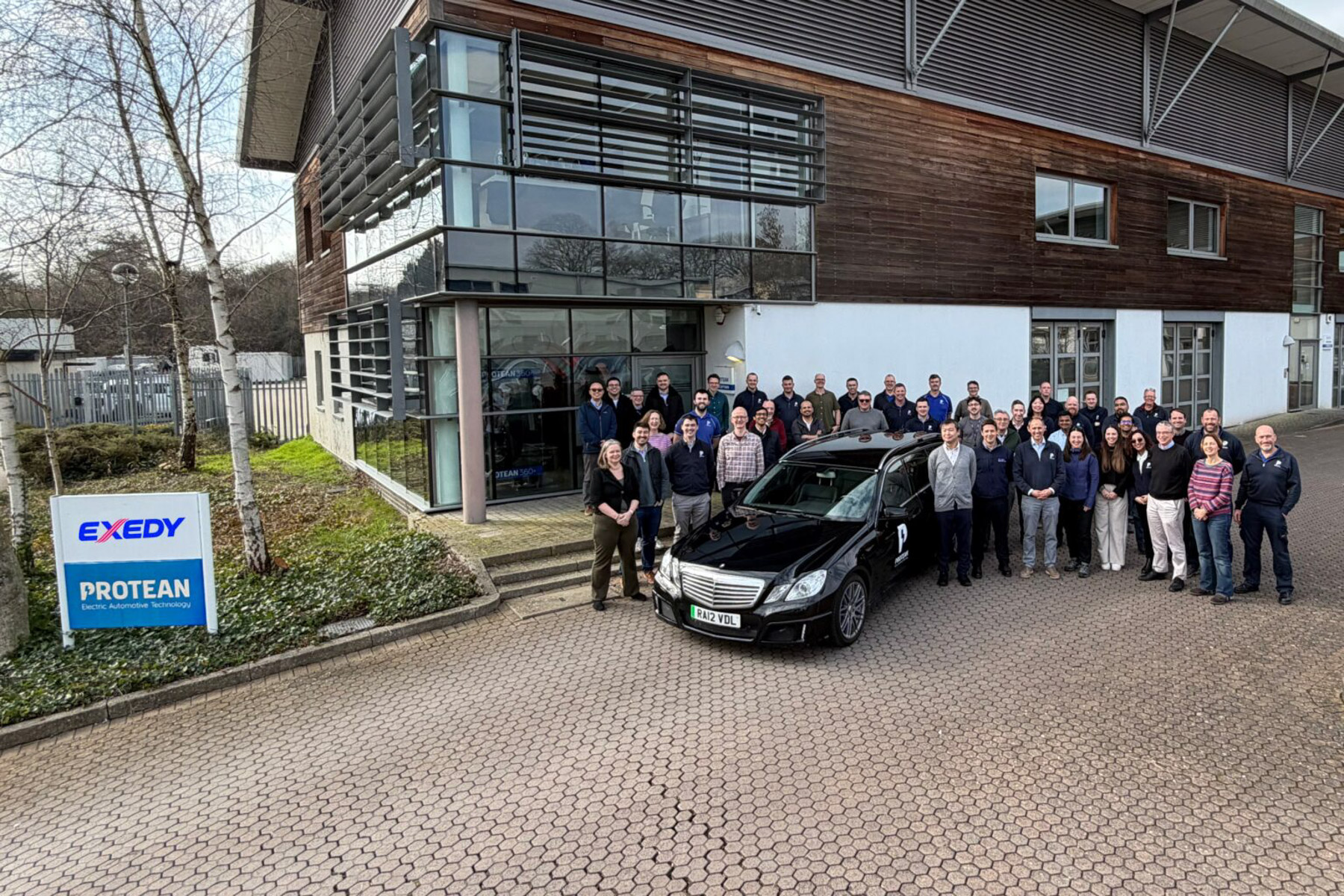
Japanese drivetrain component manufacturer Exedy Corporation has acquired British in-wheel motor specialist Protean Electric from the Bedeo Group, giving the electric propulsion technology company a new owner as the automotive industry accelerates electrification.
Financial details of the transaction were not disclosed. In a document released by Exedy, Protean Electric’s share capital is listed at just over £9 million ($11.6 million), though it remains unclear whether the purchase price matched that value or included a premium.
Protean Electric said the backing of a global automotive supplier will support efforts to scale its in-wheel motor technology. The company aims to meet growing demand for electric vehicle components while expanding production at industrial scale.
“As the automotive industry evolves and shifts towards electrification and software-defined platforms, the backing of an established Tier 1 supplier enables the further development and market expansion of Protean’s products,” the company said.
Founded in 2008, Protean Electric has changed ownership several times. The company was acquired in 2019 by National Electric Vehicle Sweden (NEVS), a successor to Saab and a subsidiary of Chinese conglomerate Evergrande.
Following financial difficulties at Evergrande and a scaling back of its electric vehicle ambitions, NEVS abandoned plans to deploy Protean’s wheel hub motor technology in its own vehicle platforms. London-based EV solutions supplier Bedeo later acquired Protean Electric in November 2021.
Protean said it appreciated Bedeo’s support during a period that included several technology milestones. These included a production nomination from an established automaker, the industrialisation of its Pd18 motor in accordance with the IATF 16949 automotive quality standard, and the homologation of a battery-electric passenger car equipped with wheel hub motors.
The company said it now expects further growth under Exedy.
“Protean Electric is looking forward to a bright future as part of the Exedy Group as it continues to advance the state-of-the-art in-wheel motors to enable its customers to offer differentiated and cost-competitive vehicles to market,” it said.
Exedy said the acquisition would combine the technological strengths of both companies.
“Through the acquisition Exedy intends to combine the technological strengths of both companies to continue providing competitive products and services,” the Japanese company said.
However, the company also noted that wider adoption of in-wheel motors may take time because vehicle manufacturers typically need to integrate the technology during early platform design stages.
“At the same time, the technology may offer advantages such as enabling a two-wheel-drive platform to be converted to four-wheel drive more quickly and at lower cost, which has attracted interest from multiple automakers,” Exedy added.
In-wheel motors are seen by some automakers as a potential way to simplify vehicle architectures and improve packaging efficiency in electric vehicles, though adoption across the industry remains limited.