
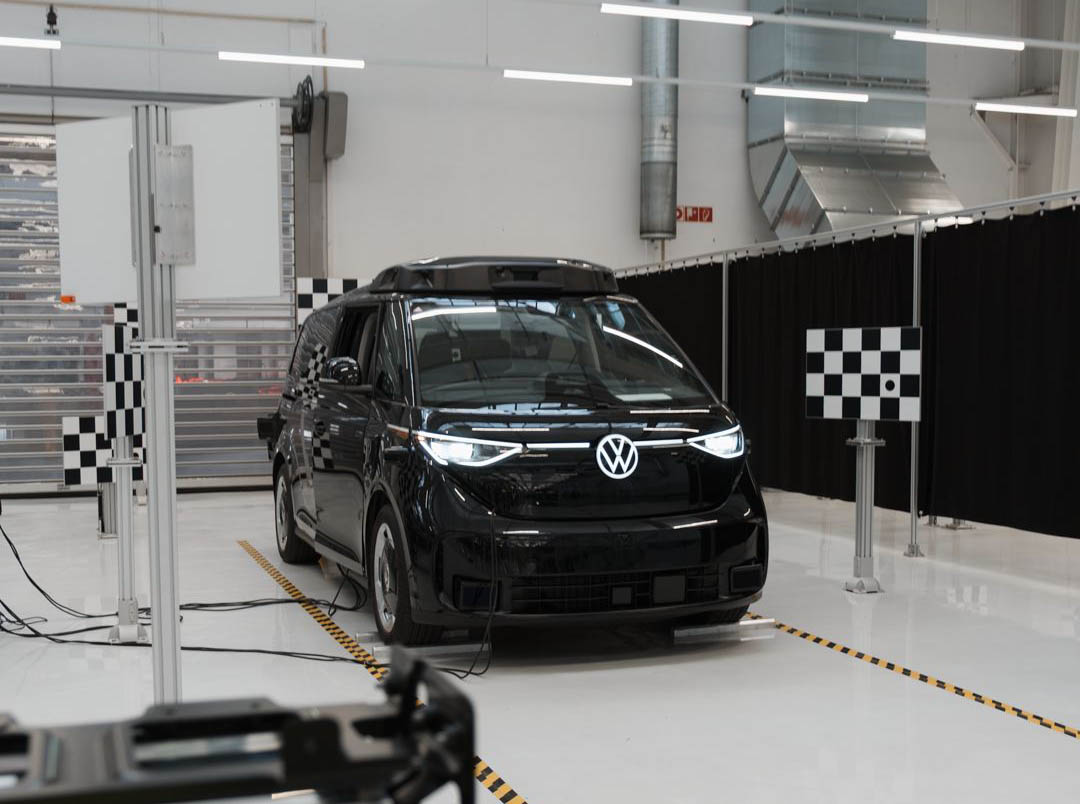
Volkswagen Commercial Vehicles has started ramping up pre-series production of its fully autonomous ID. Buzz AD electric van at its manufacturing plant in Hanover.
The company said around 500 vehicles are expected to be produced by the end of this year for pilot projects in Europe and the United States. Full series production of the autonomous model is scheduled to begin in 2027.
See also: Volkswagen Group Begins Urban Autonomous Testing of Gen.Urban Research Vehicle in Wolfsburg
Volkswagen Commercial Vehicles and its mobility subsidiary Moia have been developing the driverless version of the electric ID. Buzz for several years. The model—where “AD” stands for Autonomous Driving—was declared ready for series production in June 2025.
Initial deployments are planned as part of the ALIKE Project in Hamburg and through a partnership with ride-hailing company Uber in Los Angeles, where the company aims to deploy thousands of autonomous vehicles across several U.S. cities. Public transport operator BVG is also testing near-series prototypes of the vehicle in Berlin.
See also: Volkswagen and BVG Begin Testing Autonomous ID. Buzz Shuttles in Berlin
According to Volkswagen Commercial Vehicles, the start of pre-series production marks the industrialisation phase of the autonomous electric van. The vehicles are being equipped with autonomous driving technology developed by Israeli partner Mobileye.
The ID. Buzz AD passes through the same core production stages as standard ID. Buzz models before entering an additional manufacturing loop where specialized components are installed. These include a roof-mounted module containing cameras, radar and lidar sensors, as well as a high-performance onboard computer located on the passenger side.
After assembly, the vehicles undergo sensor calibration and system commissioning before leaving the production line.
See also: Volkswagen’s Moia Exits Hanover to Focus on Hamburg and Autonomous Mobility
Volkswagen said its subsidiary Moia will offer the ID. Buzz AD as a “turnkey solution,” combining the autonomous vehicle, driving system, fleet management software and operational services for urban mobility operators.
The vehicle is designed to operate at SAE Level 4 autonomy, enabling fully autonomous driving within predefined areas. Possible use cases include shuttle services, ride-pooling, scheduled routes and robotaxi operations.