
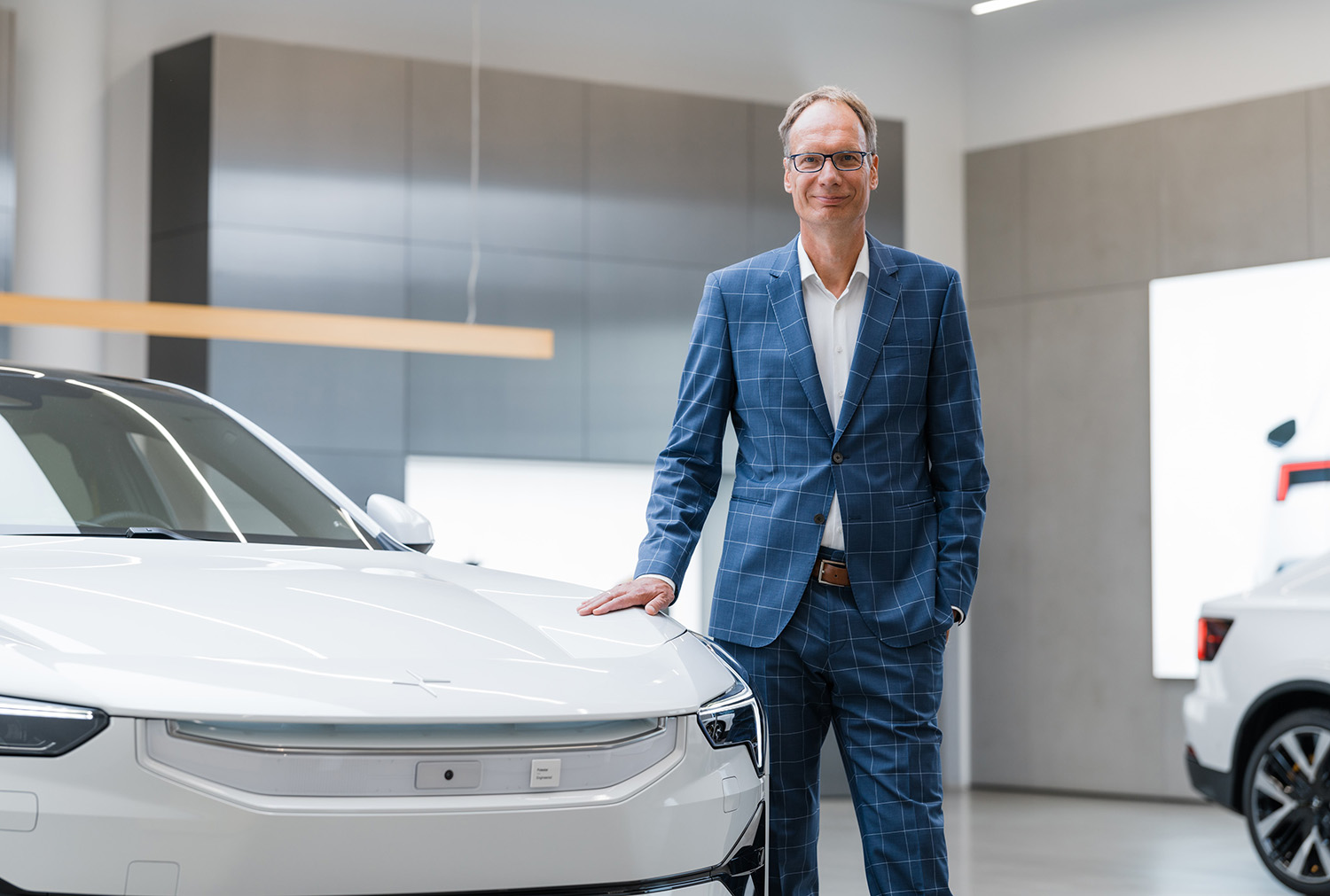
Polestar plans to place greater emphasis on high-performance electric vehicles alongside its upcoming model launches, Chief Executive Michael Lohscheller said, signaling that expansion of the brand’s lineup will include faster variants designed to compete with established performance divisions of luxury automakers.
Speaking at the company’s headquarters in Gothenburg, Sweden, Lohscheller outlined the strategy during a media gathering, according to British automotive publication Auto Express. He said future models will deliver more consistent performance characteristics across the range. “In terms of how we will continue to deliver performance with our future models, I think we’re going to deliver a more consistent way in terms of performance cars, in terms of the specifications,” he said. “We want to focus a bit more on performance, because that is where we can do even better going forward, on track, on acceleration, but also in terms of being superior to others.”
See also: Polestar Announces Major Product Expansion With Four New Electric Models by 2028
The strategy comes as Polestar works to introduce several new electric vehicles by 2028 while recovering from financial pressures that led to the closure of its last United Kingdom research and development facility and a $900 million loan from parent company Geely. Despite the shutdown of the engineering center involved in developing the Polestar 5, Lohscheller said the company retains the expertise needed to compete with performance brands such as BMW M, Mercedes-AMG and Audi RS.
Central to the plan is the expansion of the “BST” label—short for “Beast”—from a limited-production experiment into a broader high-performance sub-brand. The designation was first applied to special editions of the Polestar 2 sedan and is expected to extend to future models, potentially including the next-generation Polestar 2, the Polestar 3 SUV and the Polestar 4 crossover.
See also: Polestar Secures $400 Million Equity Injection to Bolster Liquidity
The forthcoming Polestar 5 grand tourer, which in Performance specification produces about 872 horsepower (650 kW), could also serve as a platform for more extreme variants aimed at rivals such as the Audi RS e-Tron GT and Porsche Taycan Turbo GT. Polestar previously previewed track-focused ambitions with the Concept BST based on the Polestar 6 roadster, though the company has delayed that project while prioritizing higher-volume models in mainstream segments.
Lohscheller’s comments, as reported by Auto Express, suggest Polestar intends to balance growth with its performance-oriented brand identity as competition intensifies in the premium electric vehicle market.