
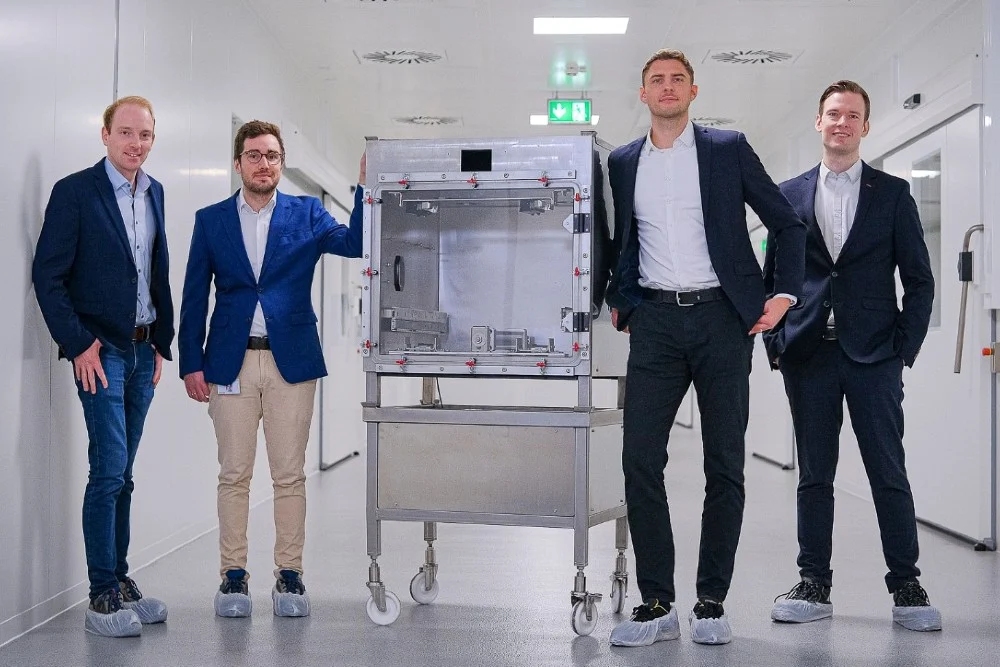
German startup Syvairo, a spin-off from the Fraunhofer Research Institution for Battery Cell Production (FFB), has developed a microclimate-controlled transport system designed to significantly reduce energy use in battery cell manufacturing, as Europe seeks to strengthen its competitiveness in the global battery industry.
Battery cell production requires extremely dry and clean environments, often maintained through large-scale clean and dry rooms with dew points reaching minus 60 degrees Celsius. According to Fraunhofer FFB, air conditioning alone can account for around one-third of total battery cell production costs, making it a major cost and energy burden for manufacturers.
See also: Fraunhofer FFB Produces First Lithium-Ion Cell Using Fully European Equipment
Researchers in Münster have focused on replacing these large climate-controlled spaces with a more targeted approach. Syvairo is now commercialising a patented intralogistics solution that encloses only individual production steps under controlled conditions, rather than entire factory halls. The startup has secured funding under Germany’s EXIST Research Transfer programme, backed by the Federal Ministry for Economic Affairs and Energy, to advance the system toward industrial deployment.
“If Europe wants to become competitive in the global battery market, cell production must become more energy- and cost-efficient. This challenge is our founding motivation,” said Oliver Krätzig, co-founder of Syvairo.
See also: Fraunhofer IWS Launches DRYplatform to Scale Solvent-Free Battery Electrode Coating
At the core of the concept is a gas-tight, microclimate-controlled transport box equipped with sensors, which functions as a mobile clean and dry room. The system allows sensitive semi-finished materials, such as coated electrode foils, to be transferred between production steps without exposure to ambient air. The transport box docks directly onto process equipment via compact airlock systems, maintaining stable conditions throughout material handling.
“The critical issue lies in transporting sensitive semi-finished products between individual process steps,” said Marius Heller, another co-founder. “To allow the rest of the production area to operate under normal climate conditions, these materials must be transferred in a contamination-free and climate-stable manner.”
According to the researchers, the approach could reduce energy demand for air conditioning by more than 50%, substantially lowering overall battery cell production costs. Syvairo said the technology is aimed at battery cell factories ranging from pilot lines to gigafactories, particularly those producing next-generation battery cells.
Beyond battery manufacturing, the company sees longer-term applications for its mini-environment concept in sectors such as pharmaceuticals, photovoltaics and aerospace, where materials must be handled under tightly controlled atmospheres. Syvairo is also exploring climate-stable transport between different production sites and the development of an autonomous measurement cube for monitoring clean and dry room conditions using wireless industrial IoT data.
See also: Fraunhofer ISE Unveils Flexible Platform to Accelerate Fuel Cell MEA Production
The technological basis for the system was developed within publicly funded research projects at Fraunhofer FFB and further advanced through the Fraunhofer AHEAD programme. With support from the EXIST programme, the solution will now be scaled into an industry-ready system and demonstrated under real production conditions at the Fraunhofer FFB PreFab facility.
“The spin-off Syvairo is an excellent example of how application-oriented production research can lead to concrete industrial solutions,” said Achim Kampker, director of Fraunhofer FFB. “We deliberately create environments where startups can test technologies under industry-like conditions and move them closer to market readiness.”