
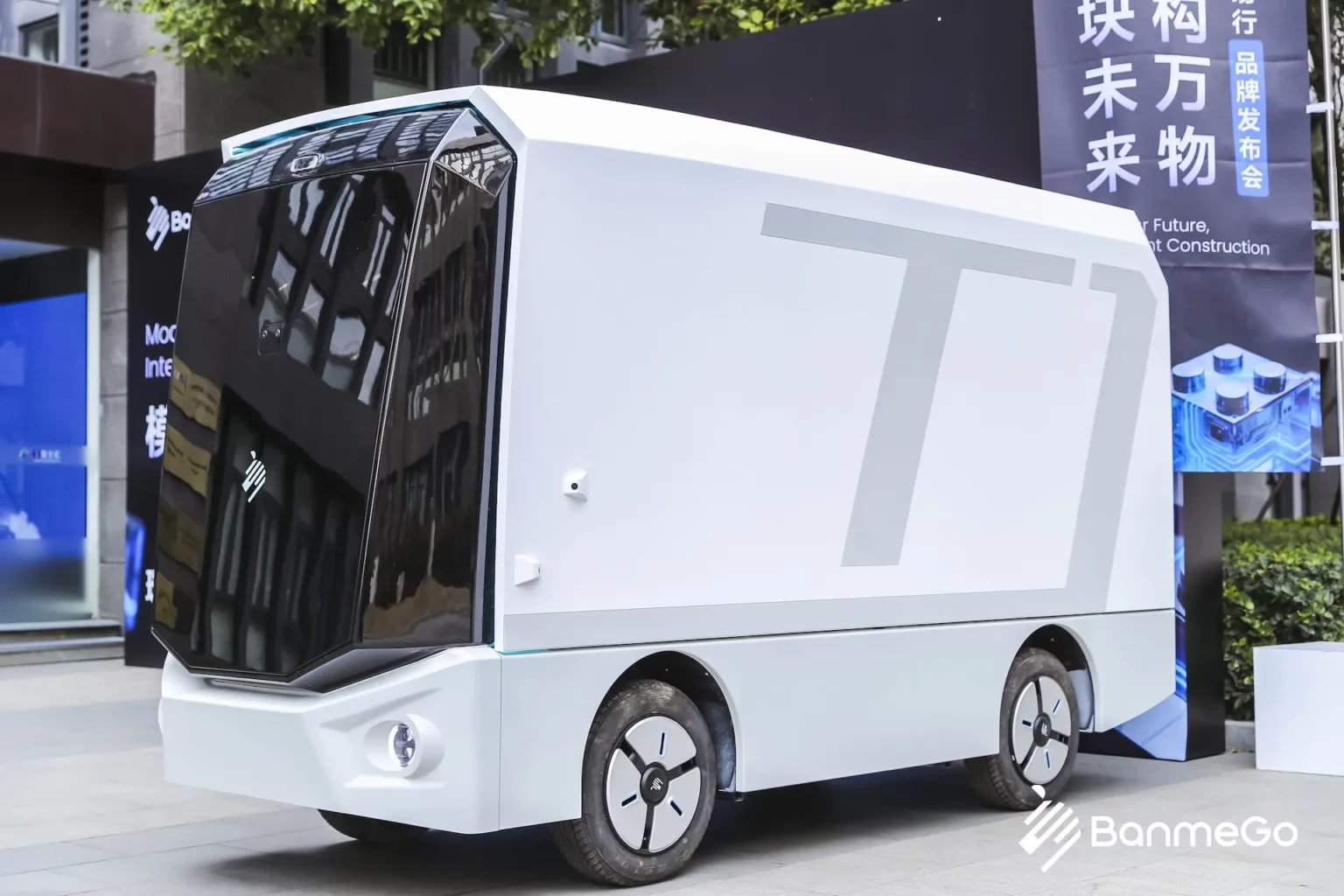
Chinese unmanned delivery company BanmeGo has launched its first autonomous delivery robot, the T6, positioning the vehicle for deployment in complex urban logistics environments, the company said at an event in Shanghai.
The T6 features a 6-cubic-metre cargo bay and is built around a modular, “LEGO-like” architecture designed to support multiple deployment scenarios, ranging from logistics parks and factory campuses to public roads. BanmeGo said the design aims to improve operational flexibility while lowering barriers to commercial adoption.
The robot is powered by an onboard computing platform delivering 550 tera-operations per second (TOPS) and runs on the company’s proprietary Smartware 2.0 middleware. BanmeGo said the system enables autonomous operations across varied environments while supporting over-the-air software updates, allowing performance improvements without hardware changes.
According to the company, the T6 uses an automotive-grade chassis engineered for reliability across different road conditions and incorporates redundant sensor arrays to maintain perception accuracy. Standardised interface protocols are intended to allow rapid integration into existing logistics workflows and infrastructure.
BanmeGo also outlined a phased technology roadmap alongside the product launch. The initial phase focuses on establishing core robot and cloud infrastructure, followed by the integration of vehicle-based end-to-end models with cloud-based agent systems. A final phase envisions expansion into additional robot form factors, operating scenarios and geographic markets.
The launch comes as Chinese logistics and e-commerce companies continue to explore autonomous delivery solutions to address rising labour costs and efficiency pressures. Industry analysts say modular designs and software-driven upgrades could play a key role in accelerating large-scale deployment of unmanned delivery vehicles in dense urban settings.