
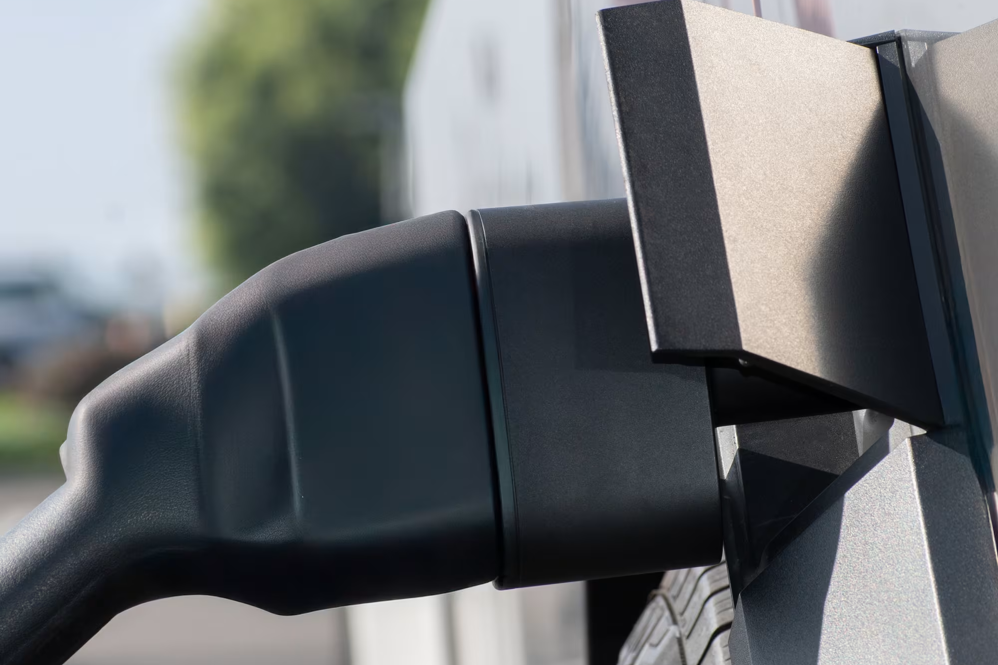
Tesla has released a redesigned CCS charging adapter that is fully compatible with its Cybertruck, ending a long-standing issue that had limited the stainless-steel pickup’s access to third-party fast-charging networks in United States and Canada.
The new CCS1-to-NACS adapter is now available for purchase, allowing Cybertruck owners to use a much wider range of DC fast chargers beyond Tesla’s Supercharger network. The move comes more than two years after the Cybertruck’s launch, during which owners discovered that Tesla’s original CCS adapter could not be used with the vehicle.
Although the Cybertruck is equipped with Tesla’s North American Charging Standard (NACS) port, many owners depend on CCS infrastructure in areas where Supercharger coverage is limited. Early testing in 2024 showed that Tesla’s first-generation CCS adapter could not properly seat in the Cybertruck’s recessed charge port, which is located inside the rear wheel arch. The bulky design of the adapter prevented a secure connection, and charging attempts failed even when owners removed trim pieces to force a fit.
Tesla’s newly released adapter appears to resolve that issue through a revised physical design. The updated unit features a pronounced “bump-out” that provides additional clearance, enabling it to connect securely within the Cybertruck’s recessed port without requiring any vehicle modifications.
In the U.S., Tesla has priced the adapter at $275 and says it supports DC fast-charging speeds of up to 250 kilowatts at compatible third-party stations.
The update is particularly significant for Canadian Cybertruck owners. While Tesla’s Supercharger network provides strong coverage along major routes such as the Trans-Canada Highway, access remains limited in more remote regions, where CCS chargers often represent the only fast-charging option.
Tesla has been working to broaden interoperability between its vehicles and non-Tesla charging networks as the company continues to expand the use of the NACS connector across North America and as competition in the electric vehicle market intensifies.