
Electric vehicle registrations in Europe rose sharply in the first ten months of 2025, outpacing the broader car market and lifting battery-electric vehicles (BEVs) to a record share of total new-car sales, according to a new study from the Center of Automotive Management (CAM).
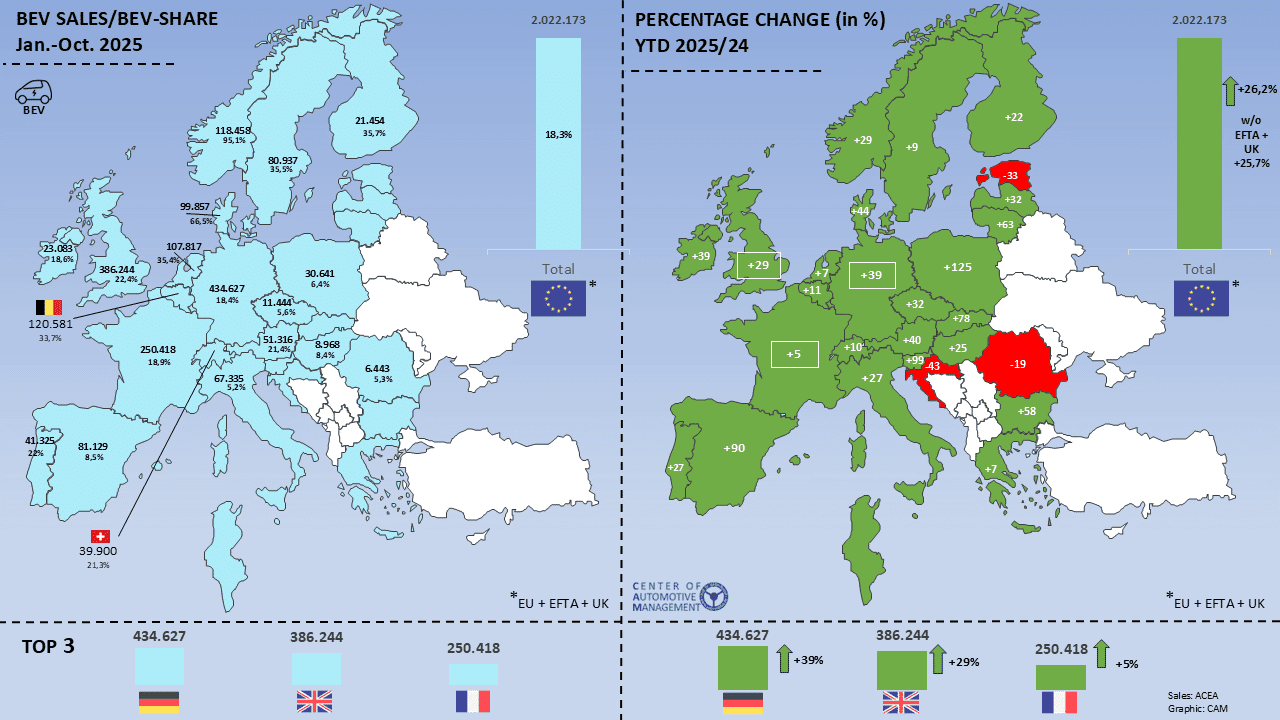
From January to October, more than 2.02 million new BEVs were registered across Europe, including the European Union, the UK and EFTA states, representing growth of 26.2% from a year earlier, the CAM “Electromobility Report” showed. By contrast, overall passenger car registrations rose by just 1.9% to around 11 million vehicles over the same period.
As a result, BEVs increased their share of the European new-car market to 18.3%, up from 15.4% in full-year 2024. CAM said the data shows that adoption of electric vehicles is continuing despite political debate over technology choices and uncertainty over the European Union’s 2035 phase-out of new internal combustion engine cars.
“In Europe, the ramp-up of electric mobility is in a critical transition phase in 2025, despite strong growth. The development remains uneven,” said CAM Director Stefan Bratzel, the study’s lead author. He warned that consumer uncertainty over future powertrain rules was holding back faster adoption. “Uncertainty typically leads to hesitation in purchasing and clinging to the familiar, so clarity must be established quickly,” he said.
The pace of electrification varies widely across the continent. Norway remained Europe’s most advanced EV market with BEVs accounting for 95.1% of new registrations, followed by Denmark at 66.5%. Sweden, the Netherlands and Belgium all posted BEV shares above 33%. Major markets such as Germany (18.4%), France (18.9%) and the UK (22.4%) were close to the European average, while Italy, Poland and Spain lagged with shares below 9%.
Germany reclaimed its position as Europe’s largest BEV market in absolute terms during the January–October period, registering 434,627 electric cars, up 39% from a year earlier. The UK followed with 386,244 units, up 29%, while France ranked third with 250,418 registrations as it prepares to extend purchase incentives into 2026.
In Germany alone, BEV registrations reached 490,368 units from January to November, up 41.3%, according to CAM and federal transport data. Electric vehicles accounted for 18.8% of new car registrations over the first 11 months of the year, and CAM forecasts full-year German BEV sales of about 530,000 units in 2025 — slightly above the previous record set in 2023.
Bratzel cautioned that any weakening of the 2035 combustion-engine phase-out could hurt long-term competitiveness, even if it eases short-term compliance costs for automakers. “If efforts in future technologies like electromobility are slowed, it could even prove to be a Pyrrhic victory for the German automotive industry,” he said.
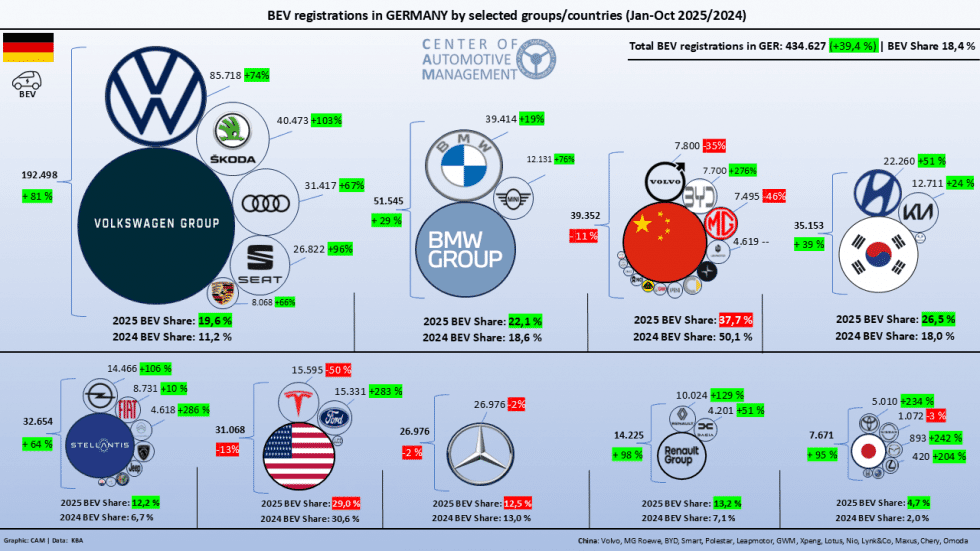
The study also showed widening gaps between manufacturers in Germany’s EV market. Volkswagen Group led BEV registrations with 192,498 units between January and October, up 81% year on year, driven largely by strong demand for Škoda models. BMW Group posted 51,545 BEV registrations, up 29%, while Mercedes-Benz saw a 2% decline to 26,976 units, although the company expects new electric model launches to lift volumes.