
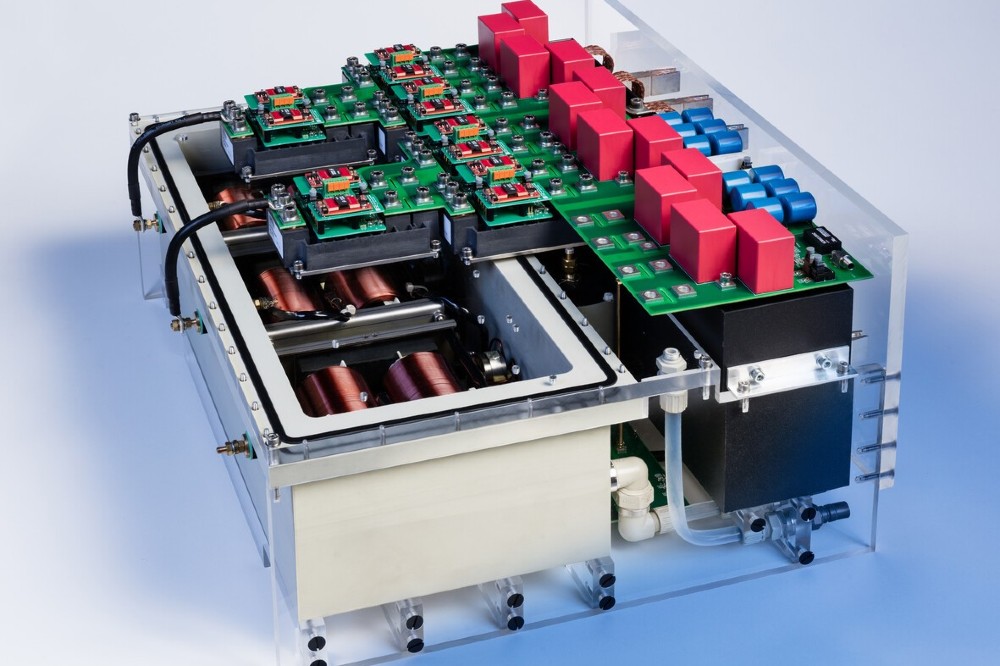
A German research and industry consortium has launched a multi-year project to develop scalable megawatt charging stations for electric vehicles, aiming to address the growing power demands of heavy-duty transport and motorway charging hubs.
The initiative, known as the ReNew Project, brings together the Fraunhofer Institute for Solar Energy Systems ISE with industrial partners including Infineon, Siemens, STS Spezial-Transformatoren-Stockach, and engineering firm Gruner. The project is funded by Germany’s Federal Ministry for Economic Affairs and Energy and targets the first full system concepts by mid-2028.
At the center of the project is the development of a medium-voltage direct current (DC) distribution system within charging hubs. Fraunhofer said this approach is intended to enable technically and economically scalable megawatt-class charging infrastructure, with key components to be developed and tested at laboratory scale.
“Future motorway charging hubs will serve both passenger cars and lorries—the power demand will explode,” said Andreas Hensel, project manager at Fraunhofer ISE. “In the ReNew project, we are developing scalable, resource-efficient system technology required for this infrastructure.”
According to the research partners, fast-charging hubs for high-traffic freight routes may require power levels of up to 30 megawatts, comparable to the electricity demand of a small town. While individual components for such systems already exist, Fraunhofer said integrated, scalable system concepts remain largely undeveloped.
The project views future charging parks as hybrid energy hubs combining battery storage and photovoltaic generation. Large parking areas could host rooftop solar installations with capacities of up to one megawatt, helping buffer grid peaks, increase on-site energy use and maintain limited operations during grid outages.
The planned architecture relies on a multi-port DC distribution network operating at three to five kilovolts, linked to the medium-voltage or transmission grid through central rectifiers. Isolated DC converters at individual charging points will manage power delivery to vehicles and storage systems, with bidirectional capabilities designed to support future grid stability.
In parallel, the consortium is developing inductive components and DC protection systems to manage the high current levels expected during megawatt charging, which remain a key technical hurdle for large-scale deployment.
Source: ise.fraunhofer.de