
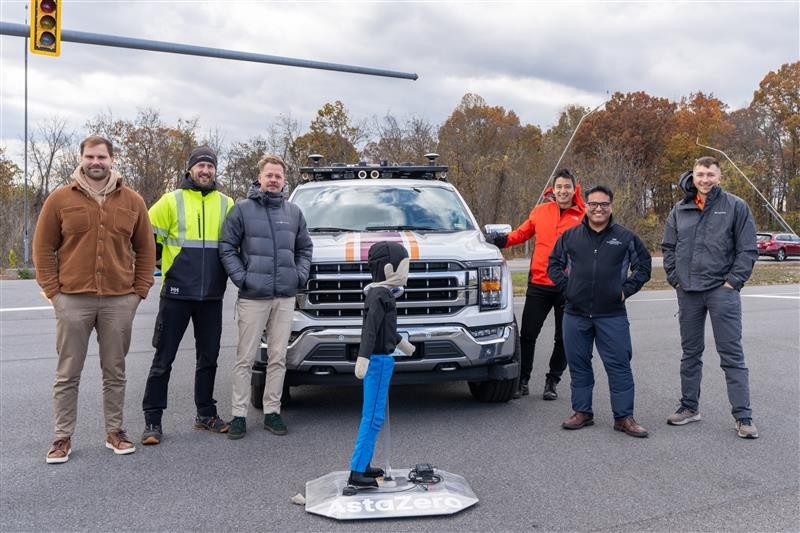
The Virginia Tech Transportation Institute (VTTI) and Sweden’s autonomous vehicle proving ground AstaZero said they have completed the first U.S. deployment of a synchronized automated testing integration aimed at standardising safety evaluation for self-driving vehicles.
The collaboration linked VTTI’s automated Ford F-150 pickup with AstaZero’s open-source Automated Vehicle Test Operating System (ATOS) on the Virginia Smart Road, allowing vehicles and robotic targets to execute fully choreographed safety scenarios without human intervention.
See also: German-Led CeCaS Project Unveils Centralised Software Architecture for Future Autonomous Vehicles
In a demonstration, a Level 4 autonomous truck was tested in a simulated left-turn intersection scenario as a pedestrian dummy moved into its path using an automated carrier platform. The vehicle detected the obstacle and stopped repeatedly under identical test conditions, the partners said.
“We want to make sure we have a repeatable process for testing current systems, new systems that are developed, and more complex scenarios as this technology grows,” said Mike Mollenhauer, VTTI’s division director of technology implementation.
See also: Waymo Data Shows Most Robotaxi Trips Carry Two Passengers or Fewer
Testing was carried out on VTTI’s Smart Road in Blacksburg, Virginia, which includes rain and fog simulation capabilities not available at AstaZero’s dry-track facility in Sweden. The partners said the goal is to develop scalable, industry-wide safety validation methods to support future commercial deployments of automated vehicles.