
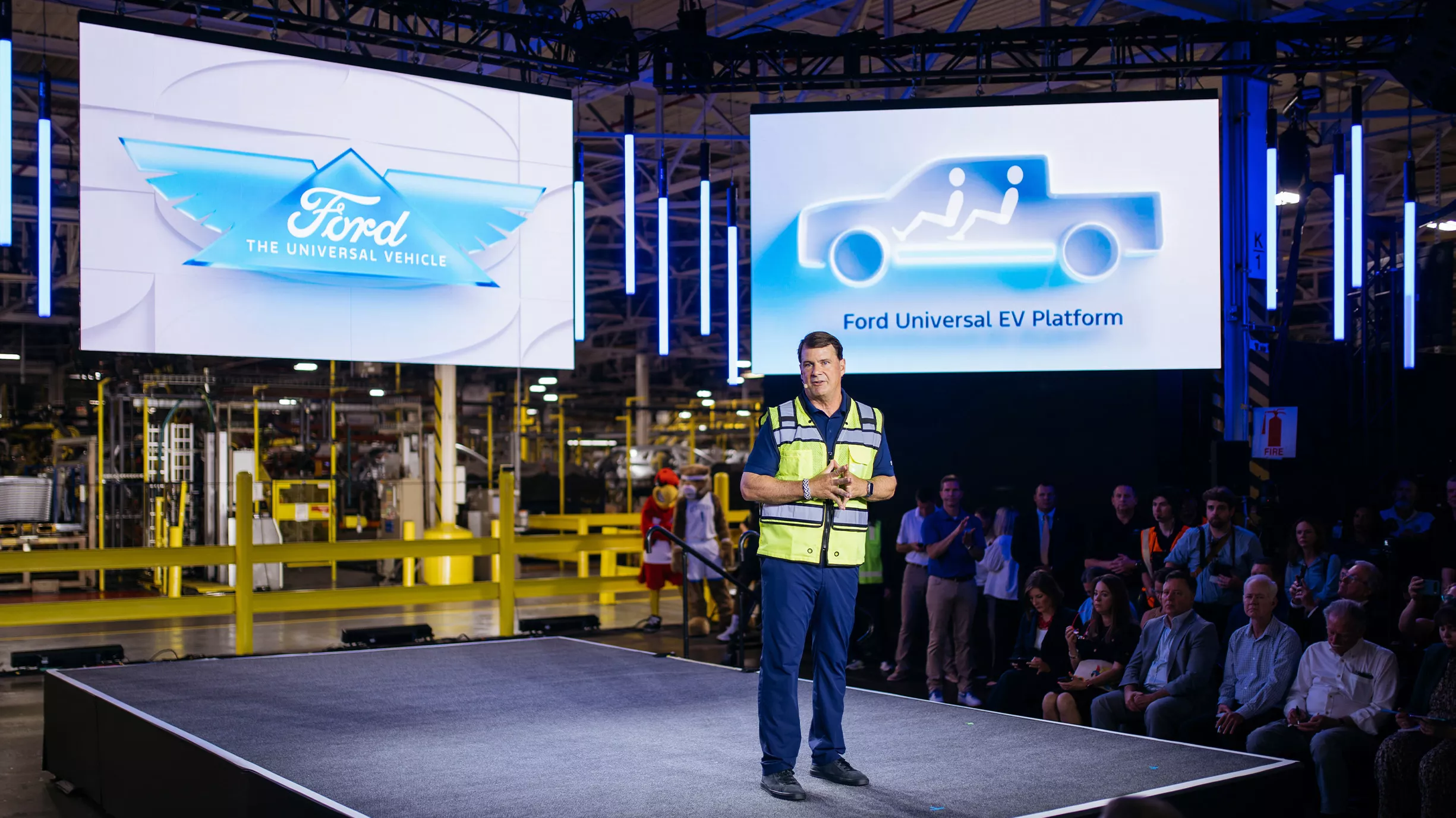
Ford Motor is developing its next generation of electric vehicles around a newly unveiled Universal EV Platform (UEV), aiming to sharply cut production costs and broaden access to affordable electric vehicles in North America, the company said.
The platform, revealed in August, will debut with a mid-size electric pickup scheduled to enter production in 2027. Ford has previously indicated the truck is expected to start at around $30,000, positioning it among the most affordable electric pickups on the U.S. market.
See also: What We Know So Far About Ford Universal EV Platform
Ford Chief Executive Jim Farley said cost reduction was the primary objective of the new architecture, but not the only one. “First of all, the UEV was designed for two priorities: the lowest possible cost platform with multiple top hats in one facility and designed to really compete in the heart of what we believe is the new EV market in North America, which is affordable commuter vehicles,” Farley told investors during the company’s third-quarter earnings call. “We think this product’s literally at the center of the future of the EV market in the U.S.,” he added.
The Universal EV Platform will initially be produced at Ford’s Louisville Assembly Plant using newly developed manufacturing processes, with the option to expand production to additional facilities in the future. Ford said the architecture was designed by a newly assembled engineering team and emphasizes simplicity and manufacturing efficiency.
See also: Ford Commits $5 Billion to Build LFP-Powered Midsize EV and Universal EV Platform in the U.S.

According to Ford, the UEV platform uses about 20% fewer parts than a conventional vehicle, along with 25% fewer fasteners and 40% fewer workstations along the assembly line. These changes are expected to reduce total assembly time by roughly 15%, contributing to lower overall vehicle costs.
Ford has previously shown six potential vehicle formats that could be based on the Universal EV Platform, including a compact crossover, mid-size crossover, three-row crossover, pickup truck, cargo van and passenger van. While only the mid-size electric pickup has been confirmed for production so far, the company has indicated that the platform is intended to support a broader range of future electric models.