
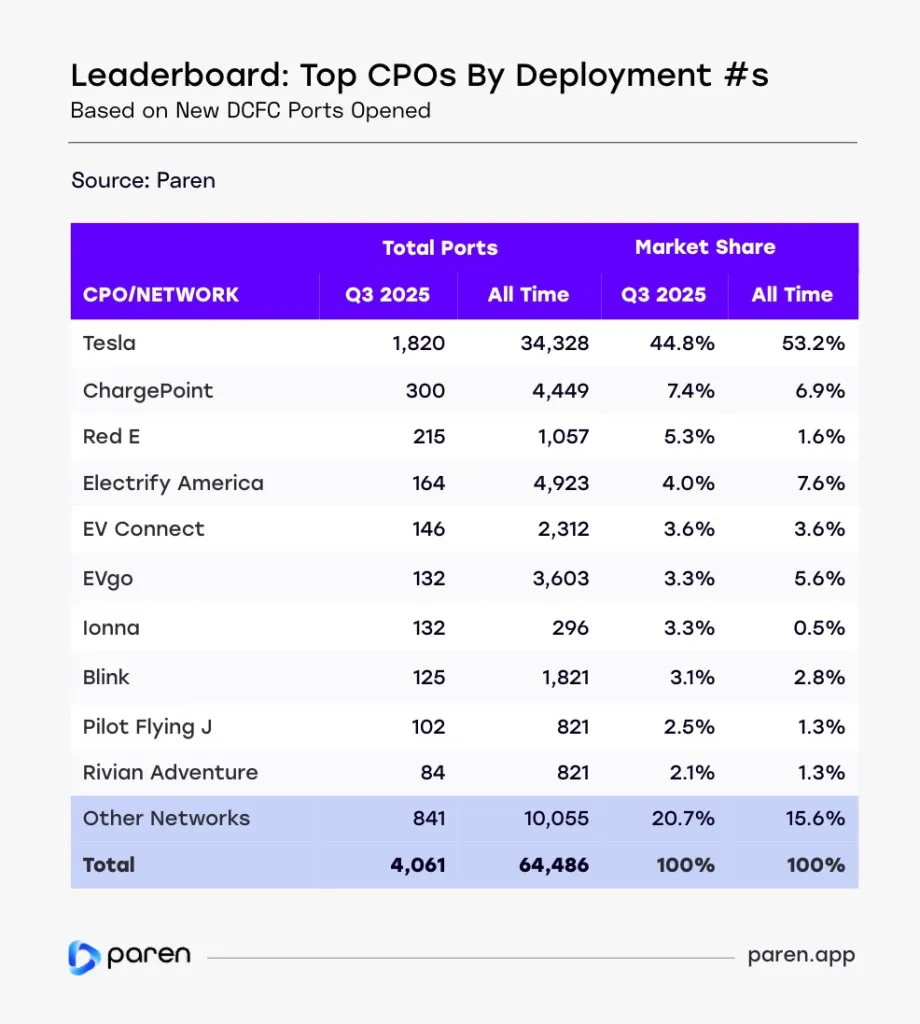
The United States added more than 4,000 new direct-current (DC) fast-charging ports in the third quarter of 2025, bringing the national total to 64,486 across 12,375 stations, according to the latest report from EV charging data platform Paren.
While the pace of new openings slowed slightly—699 stations were added, down 12% from the previous quarter, and 4,061 new ports, down 7.7%—Paren noted that these dips mirror seasonal trends seen in 2024 and anticipate a rebound in Q4. The report also highlighted a shift toward larger stations, with 27% now offering eight or more stalls, up from 23% last quarter.
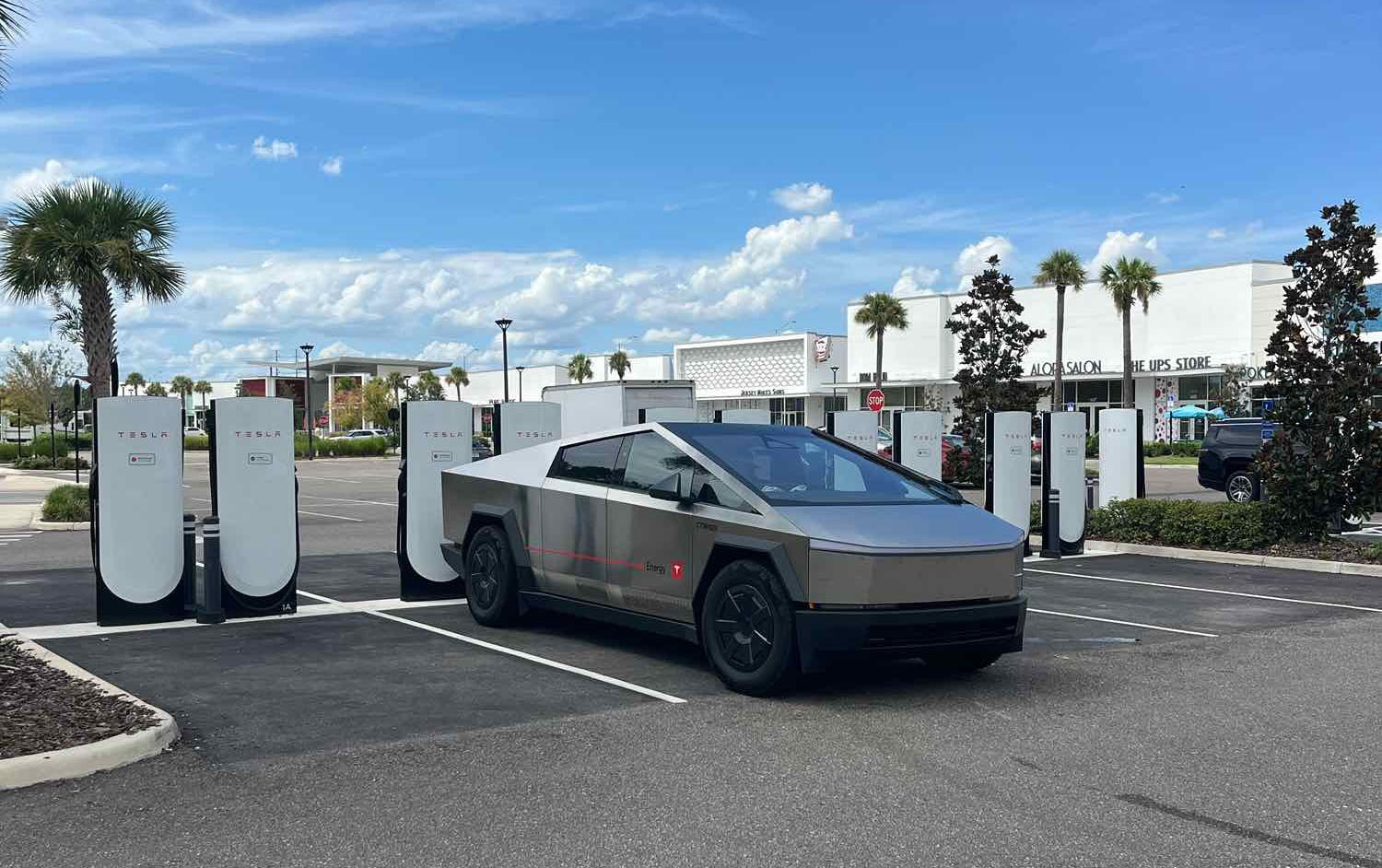
Tesla led the quarter’s expansion, contributing 1,820 new ports, nearly 45% of the total added nationwide. ChargePoint, Red E, Electrify America, and EV Connect followed with 300, 215, 164, and 146 ports, respectively. Regional and smaller operators accounted for 21% of new ports, illustrating a more diversified market. California led state growth with 108 new stations, followed by Texas, New York, Florida, and Illinois. New entrants such as Ionna, a network formed by seven automakers, opened 12 stations with 132 ports, while Red E expanded across 18 states, including new sites at Aldi supermarkets.
Increased travel over the summer drove higher utilization, with fast chargers seeing more activity in 45 states. Maine recorded the largest usage growth (+1.9), followed by Montana, New York, and Oregon (+1.8 each), reflecting busier tourism routes and expanded highway infrastructure. Paren noted that Tesla’s opening of its Supercharger network to non-Tesla EVs may be influencing charging patterns, with some non-Tesla stations seeing minor declines in use.
See also: ICCT Study: Europe to Require Up to 5,300 Megawatt Chargers for Electric Trucks by 2030
Reliability of charging stations improved slightly, reaching 92.3% from 92.1%, with 32 states showing gains and 15 recording declines. Paren highlighted that reliability now depends more on operator performance, preventive maintenance, and software integration than geographic location. Oklahoma showed the largest improvement (+4.4%) but remained the lowest-rated state at 73.3%, while Mississippi (+2.6) and Idaho (+2) made notable gains.
Average DC fast-charging prices edged up by one cent to $0.49 per kilowatt-hour, with most states ranging from $0.48 to $0.54. Hawaii remained the most expensive at $0.85/kWh, while Nebraska had the lowest at $0.42/kWh. Some states saw notable fluctuations, including Alaska (+$0.04), Arkansas (-$0.05), and Hawaii (-$0.07). Paren noted that future price trends will depend on wholesale electricity costs, demand, and network competition.