
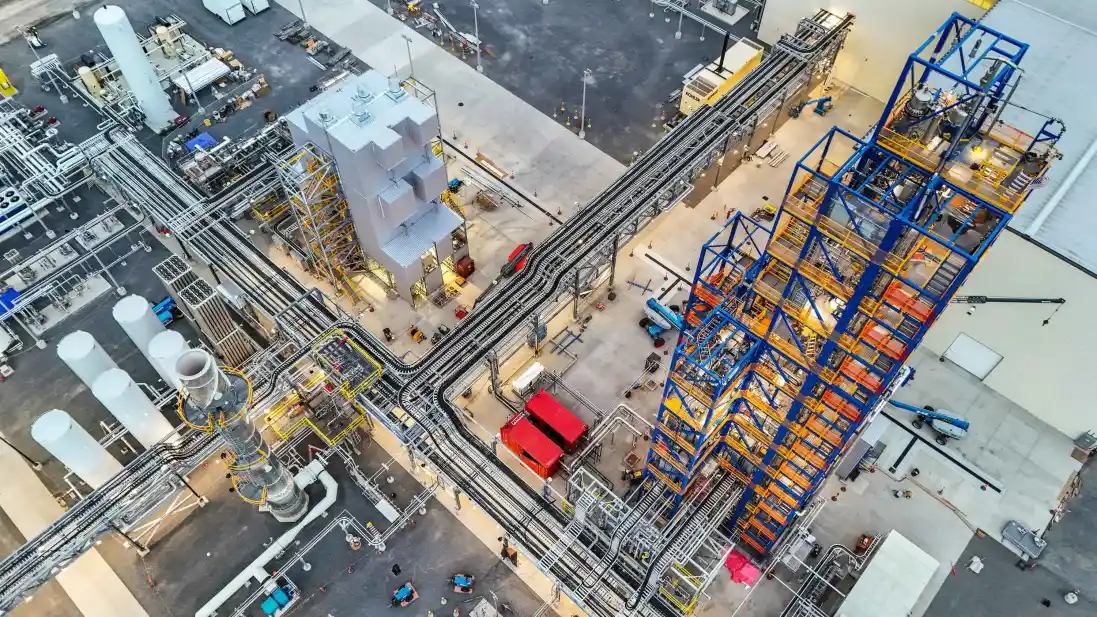
Sila, a battery materials startup, has begun operations at its new facility in Moses Lake, Washington, marking the launch of the first large-scale silicon anode plant in the United States. The milestone could enable automakers to deliver longer-range and faster-charging electric vehicles (EVs).
The factory, under construction for nearly two years, will initially produce enough material for 20,000 to 50,000 EVs, with future expansion planned to support as many as 2.5 million vehicles. “When you invent something new, it’s a lot easier to then produce it where you invent it,” co-founder and CEO Gene Berdichevsky told TechCrunch.
Silicon anodes have the potential to boost the energy density of lithium-ion batteries by up to 50%, a technology Sila has spent 14 years developing. The company has already signed supply agreements with Panasonic and Mercedes, while also selling to drone, satellite, and consumer electronics firms.
Berdichevsky said Washington was chosen for its low-cost hydropower, available land, and access to local raw materials. “The cost structure of this technology is predicated on low-cost energy — one of the big inputs — and then some key precursors, and we have that in Washington,” he said.
Sila raised $375 million last year to finance the project. The company’s first production runs will validate that its factory output matches the material customers have been testing from its R&D line in Alameda, California. “We have a lot of confidence in that, but obviously the proof’s in the pudding,” Berdichevsky said.
The startup is competing with other U.S.-based silicon anode developers including Group14, which also operates in Moses Lake, and Amprius in California. But Berdichevsky said Sila’s site is “really the first auto scale silicon anode plant in the U.S.”
Looking ahead, he said batteries using Sila’s material could be cheaper than those relying on graphite sourced from Western suppliers. Silicon anodes could also reduce the need for costly metals such as nickel, while enabling faster charging and strengthening domestic supply chains.
“There’s not a CEO of a Western automaker that doesn’t believe that within a decade, or maybe 15 years at the limit, they’re going to be selling almost all electric vehicles,” Berdichevsky said. “If you play it out 10 years from now, you probably have 10 million EVs in the U.S., so we’re going to need multiple sites.”
While expansion into Europe and Asia remains a long-term goal, Berdichevsky stressed his focus on building U.S. capacity. “As a country, if you don’t make stuff, where’s your pride going to come from?” he said. “I think it’s just so important for us as a country to continue to learn to do this and create the ecosystem so that we can never fall behind again.”