
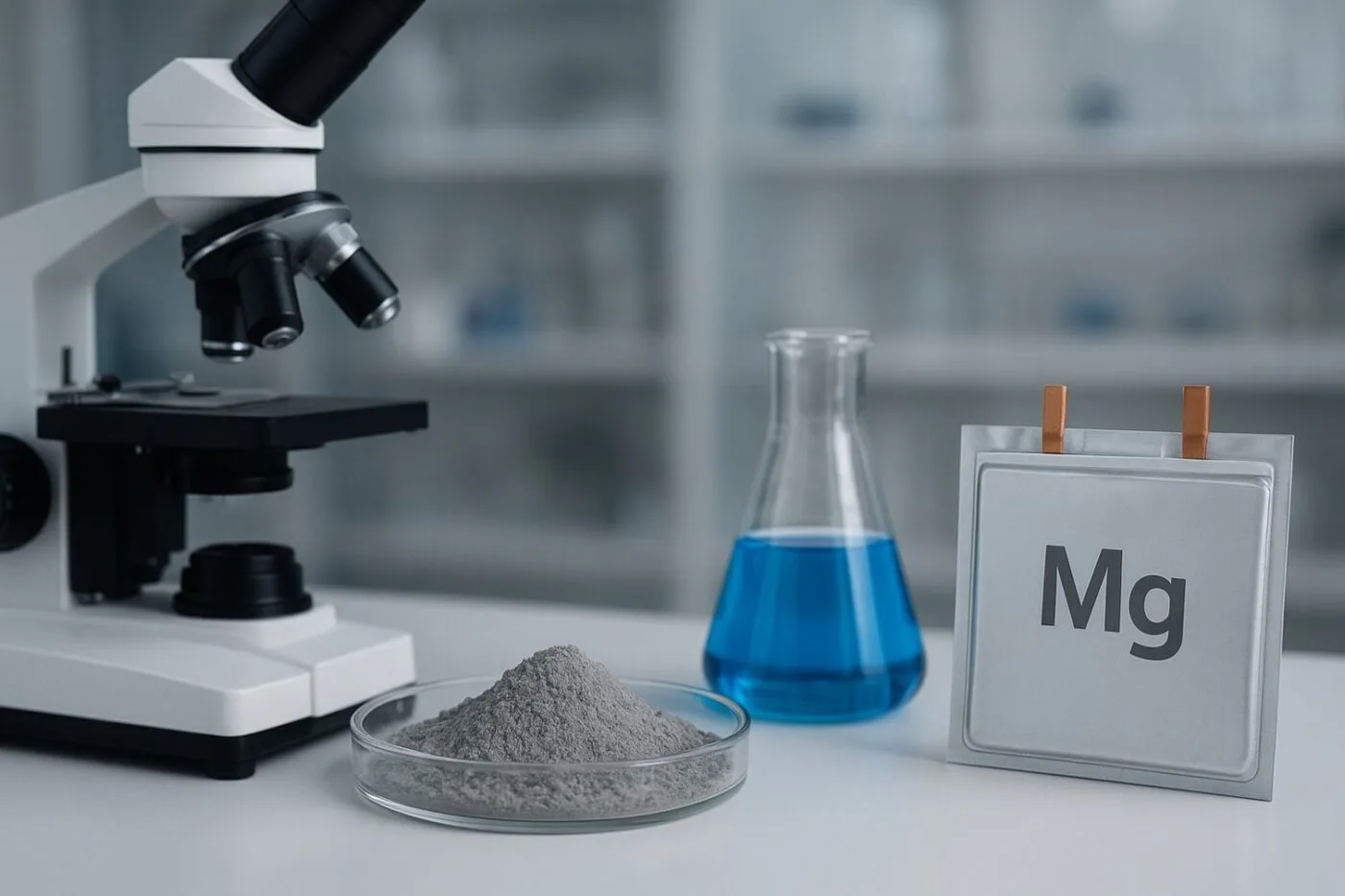
The EU-funded HighMag project, coordinated by the AIT Austrian Institute of Technology, has launched a Europe-wide initiative to develop magnesium-based batteries designed to support the shift toward electrified transport and renewable energy. The program focuses on creating high-performance, safe and sustainable energy storage solutions while maintaining compatibility with existing lithium-ion production lines.
HighMag is developing two battery architectures: magnesium-sulphur systems with conversion cathodes and magnesium-metal systems with insertion cathodes. A coated magnesium anode powder is being designed for both approaches. The project follows the principle of Safe and Sustainable by Design (SSbD), with work spanning from materials development to pilot-scale pouch cell validation. The objective is to raise the technology readiness level from TRL 2 to TRL 4.
“Magnesium is at the forefront of the next generation of batteries,” said Dr Yuri Surace, Senior Scientist at AIT and HighMag project manager. “With HighMag, we are developing sustainable, powerful and cost-effective alternatives to lithium-ion batteries. Our goal is to advance the technology from the laboratory to pilot production—an important step toward safe and resource-efficient storage solutions for mobility and the energy transition.”
Magnesium is more abundant and safer to handle than lithium, while also offering high theoretical storage capacity, according to the consortium. The research also addresses key challenges such as low electrochemical activity and limited stability. Prof Andreas Kugi, Scientific Director of AIT, called HighMag “a flagship project of European battery research,” adding that “by advancing magnesium batteries from fundamental research to industrial feasibility, we are strengthening Europe’s technological sovereignty and laying the foundation for a sustainable and resilient energy future.”
The consortium includes 13 institutions from Europe and Israel, among them the University of Limerick, CEA, KIT, ZSW, Imperial College London and the Paul Scherrer Institute, alongside industrial partners such as Danube Cell Manufacturing GmbH and Amazemet Sp. z o.o. AIT’s Battery Technologies Competence Unit is leading work on manganese-based insertion cathodes, electrode scaling, gas analysis for safety, pouch cell prototypes and recycling strategies.