
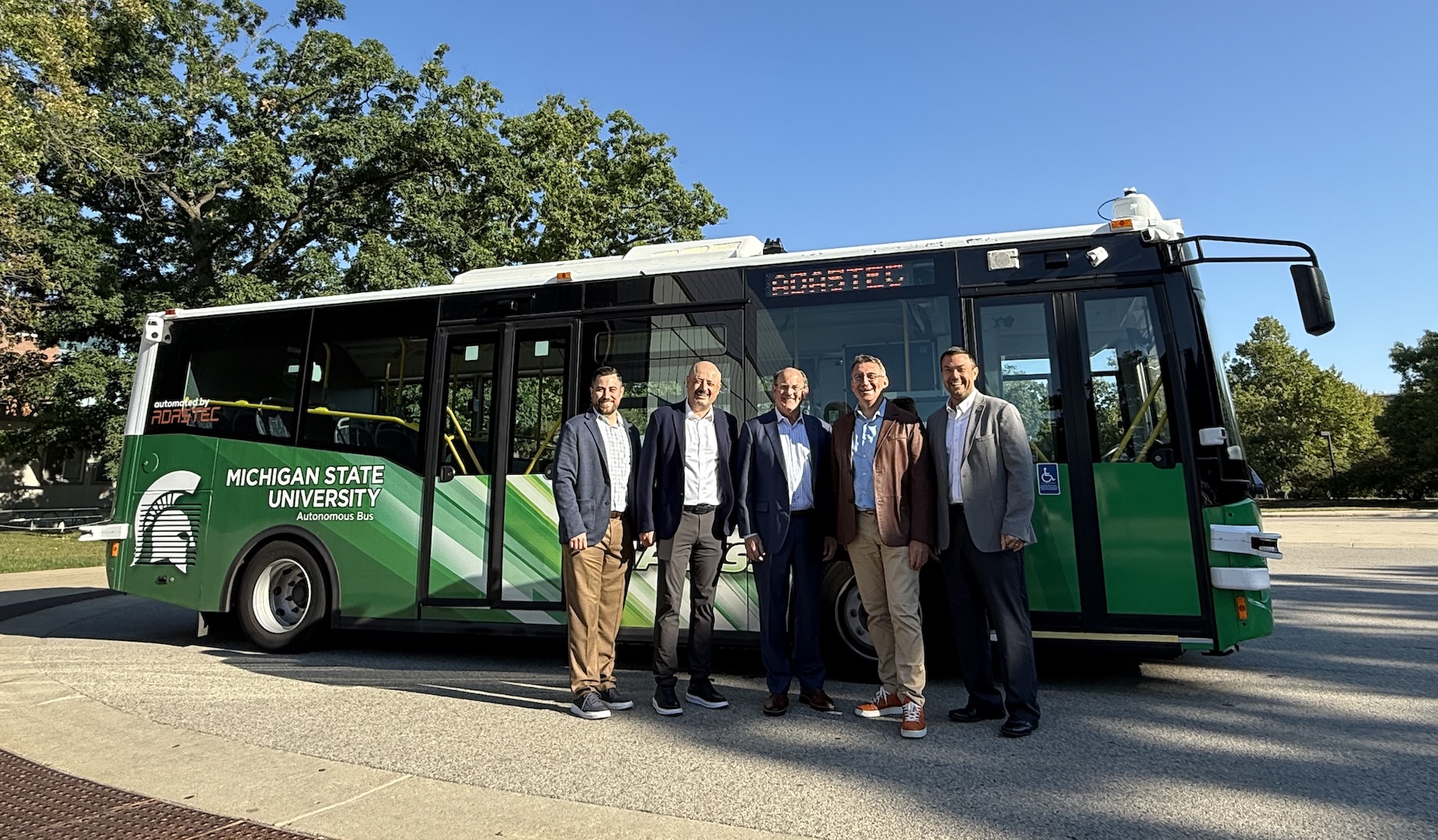
ADASTEC has introduced a fully autonomous electric bus service at Michigan State University (MSU), aiming to enhance campus mobility while supporting research on automated vehicle systems.
The bus, named SpartanXpress, is a full-size SAE Level-4 vehicle that meets U.S. Federal Motor Vehicle Safety Standards (FMVSS) and Americans with Disabilities Act (ADA) requirements. Operating along a 5.12-mile loop through the central campus, it connects commuter lots, academic buildings, and cultural venues. The service runs Monday through Friday between 10:05 a.m. and 2:35 p.m. and is free for students, staff, and visitors.
“The SpartanXpress is more than a transit service—it’s a platform for innovation,” said Judd Herzer, MSU’s Director of Mobility and Innovation. “It integrates seamlessly into our transportation network, offering safer, sustainable, and accessible mobility while providing research opportunities for students and industry partners.”
Equipped with ADASTEC’s flowride.ai platform, six LiDAR sensors, six radars, eleven RGB cameras, and C-V2X connectivity, the bus autonomously handles steering, acceleration, and braking in mixed traffic environments. It communicates with roadside units and traffic lights to navigate intersections and crosswalks, including during light snow or rain, while maintaining a top speed of 25 mph. The vehicle also features an automated accessibility ramp to ensure inclusive boarding.
The deployment is part of a three-year research collaboration between ADASTEC and MSU. Students have the opportunity to collect and analyze operational data, providing hands-on experience with advanced automated vehicle technology. Dr. Ali Peker, CEO of ADASTEC, said the initiative is intended as a model for combining technology, accessibility, and sustainability in public transit.
The SpartanXpress route links key campus locations such as Commuter Lot 89, Wilson Road, Anthony Hall, the Wharton Center Loop, IM East, and the Natural Resources building, enhancing connectivity for the MSU community. ADASTEC, headquartered in East Lansing, has previously deployed its technology in 12 projects across 11 countries.