
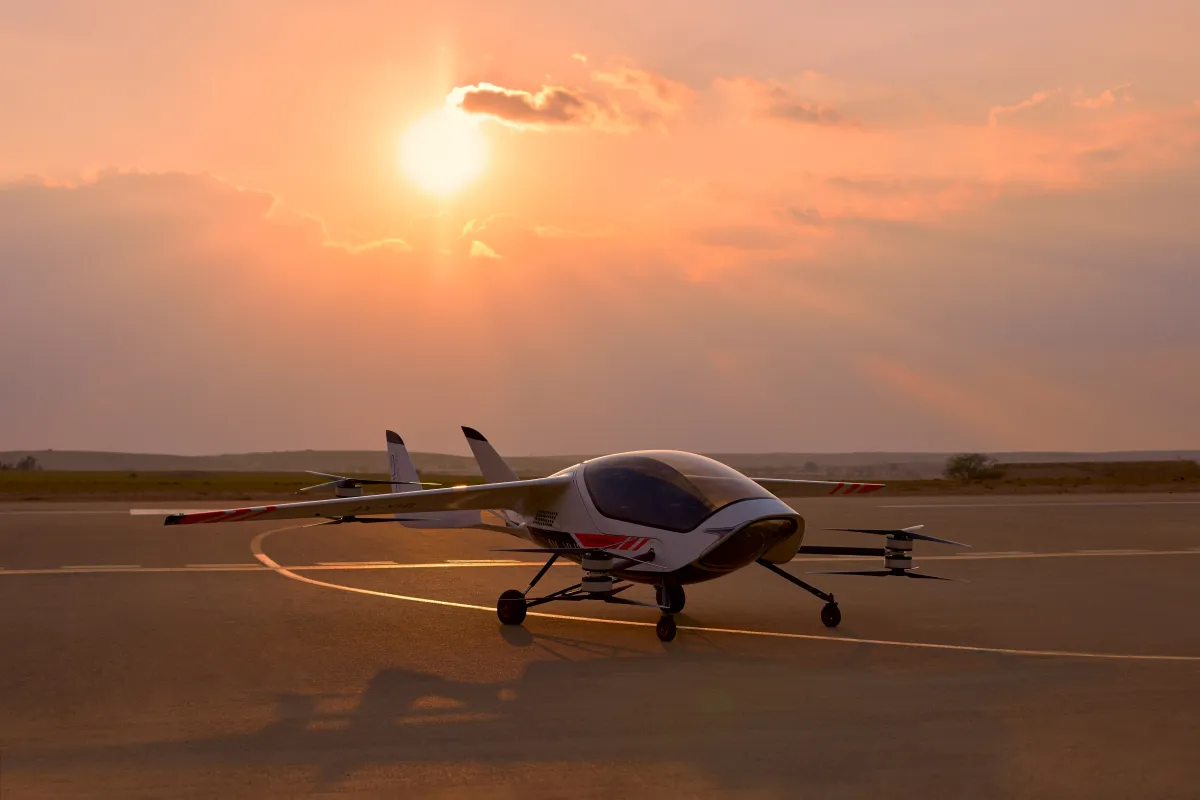
Israeli electric aviation company AIR has raised $23 million in Series A funding to accelerate development and production of its electric vertical takeoff and landing (eVTOL) aircraft for both personal and defense applications, as geopolitical tensions and regulatory changes reshape the advanced air mobility sector.
The funding round, led by Entrée Capital with support from early investor Dr. Shmuel Harlap, will be used to scale AIR’s manufacturing capabilities in Israel, expand its team, and support entry into the U.S. market. AIR’s CEO and co-founder Rani Plaut said the company’s design philosophy focuses on flexibility and efficiency by building both piloted and uncrewed aircraft on a shared platform.
“What sets AIR apart is the shared design DNA between both aircraft variants,” Plaut said. “This unified architecture allows for cross-platform upgrades, meaning advancements in one model can be applied to the other, streamlining development, manufacturing, and scalability.”
AIR currently offers the AIR ONE, a two-seat personal eVTOL, and an uncrewed variant aimed at logistics and defense missions. Since delivering its first cargo eVTOL in late 2023, the company has secured over 2,500 preorders for the AIR ONE and plans to deliver 15 cargo aircraft this year.
The company’s cargo aircraft operate under Experimental Airworthiness Certificates (EACs), which allow for test flights and limited logistics operations. “Our launch customer is flying under an Experimental Airworthiness Certificate, which will convert to a ‘Type’ certificate once the uncrewed eVTOL completes the certification process,” Plaut said.
While Type certification is required for full commercial operation, the AIR ONE is being developed under the FAA’s updated MOSAIC rule for Light Sport Aircraft (LSA). “We designed the AIR ONE from day one to align with the MOSAIC LSA criteria, anticipating a more streamlined certification pathway,” Plaut added. “Now that the rule is finalized, we’re on track to become the first piloted eVTOL certified under LSA to reach private customers. Our goal is to begin deliveries as soon as the rule becomes enforceable in 2026.”
Despite increasing interest in the U.S. market, where defense and commercial contracts are gaining prominence, AIR is not yet manufacturing its aircraft domestically—a factor that could limit access to government deals. Competitors such as Joby Aviation, Archer Aviation, and Beta Technologies have already secured military and airline partnerships.
Still, AIR is aiming to close the cost gap through industrial scalability. “We’re closing the cost gap by applying automotive-grade manufacturing principles for scalable production,” said Plaut. The company also emphasized its aircraft’s compact design and convenience. “The size and folding-wing mechanism solve a major infrastructure hurdle,” Plaut noted. “They don’t require airports or complex handling — just a flat surface — and can park in most garages or driveways.”
AIR’s uncrewed model also supports simplified operations. “Our uncrewed aircraft follows simplified SOPs, which allows even minimally trained ground crews to operate it,” Plaut said. The company views these features as crucial advantages in both commercial logistics and defense scenarios, as it prepares to expand into global markets.