
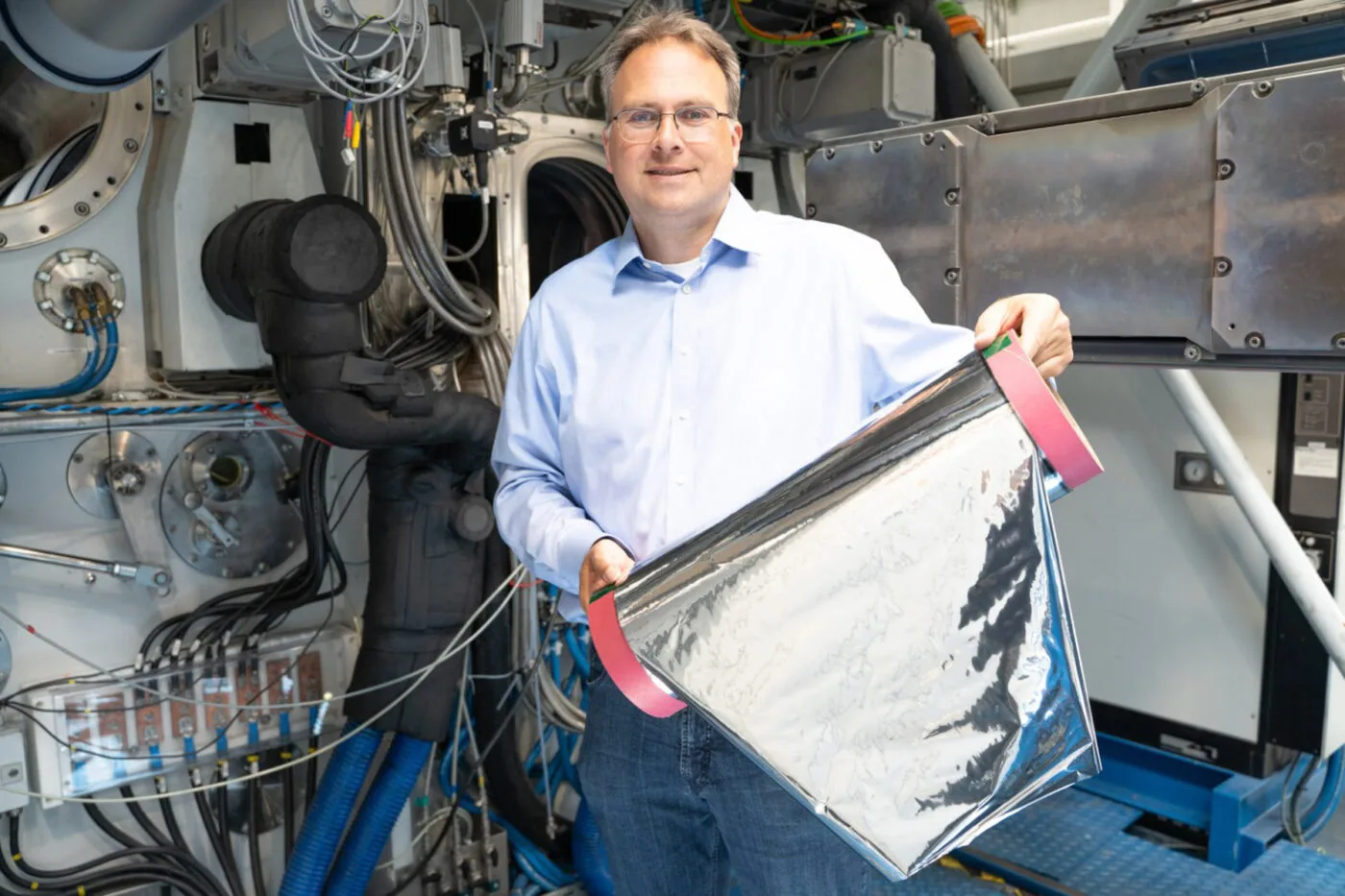
The Fraunhofer Institute for Electron Beam and Plasma Technology (FEP) has introduced a novel roll-to-roll production process that enables the manufacture of polymer-based current collectors for lithium-ion batteries. This technology substitutes conventional metal foils with polymer films coated in thin layers of copper or aluminium, offering a potential reduction in battery weight without compromising performance.
The innovation, developed by researchers in Dresden, uses electron beam evaporation to deposit metal layers just one micrometre thick onto both sides of a 12-micrometre polyethylene terephthalate (PET) film. The result is a current collector that closely matches the conductivity and thickness of traditional copper or aluminium foils. “The challenge was to design the polymer films and the coating process in such a way that the thickness of the current collector could be comparable to that of current metal films and the metal layer could have optimum electrical conductivity,” said Claus Luber, technical project manager at Fraunhofer FEP.
According to the research team, the new current collectors remained smooth and wrinkle-free after the coating process, which is essential for integration into standard battery production. The coated polymer substrates also provide a safety benefit: in the event of an internal short circuit, the polymer melts and breaks the current path, helping to prevent thermal runaway.
The technology was tested in the PolySafe project, funded by Germany’s Federal Ministry of Education and Research (BMBF). Working with project partner TU Braunschweig, the team produced and evaluated pouch cells incorporating the polymer-based current collectors. “These cells were tested for their electrochemical properties and compared with conventional reference cells. In these tests, the cells with metal-on-polymer current collectors performed similarly to the reference cells in terms of performance and cycle stability at different charging and discharging rates,” the institute reported.
Fraunhofer FEP described the outcome as a “valuable basis for optimizing lithium-ion batteries,” highlighting its potential to support lighter, safer battery designs in industrial applications.