
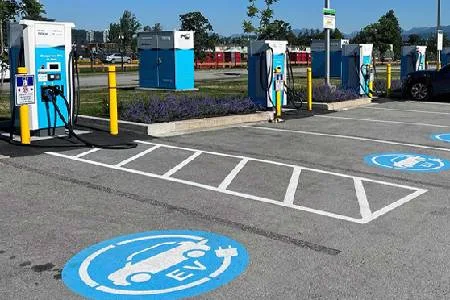
BC Hydro has significantly expanded its electric vehicle (EV) fast-charging infrastructure across British Columbia, tripling the number of public charging ports over the past year to a total of 591, the utility said on Friday. The increase represents an average of more than one new charging port installed per day.
The utility opened 22 new charging hubs throughout the province, with each hub featuring between eight and 22 ports. Some locations also introduced new 350-kilowatt high-power chargers, allowing faster charging for compatible vehicles.
The expansion comes as British Columbia’s EV adoption accelerates. BC Hydro estimates about 195,000 EVs are currently on provincial roads, a number expected to rise to between 700,000 and 900,000 over the next decade. The utility has also scaled up its charging network’s capacity from 10 megawatts in April 2024 to 41 megawatts by March 2025.
“B.C. is home to one of the fastest-growing EV communities in North America,” said Adrian Dix, Minister of Energy and Climate Solutions. “Together with BC Hydro and other partners, we have built one of Canada’s largest public EV charging networks to help reduce range anxiety and encourage more British Columbians to make the switch to electric vehicles.”
BC Hydro noted that 85% of the charging ports in its network are fast chargers and support a range of plug types, including CCS, NACS, and CHAdeMO connectors.
Following the completion of the province’s “Electric Highway” project, fast-charging stations are now available approximately every 150 kilometres along major travel routes. BC Hydro operates about 70% of these stations, equating to 155 fast-charging sites.
Looking ahead, the utility aims to expand to 800 charging ports by 2026. Plans for this year include the launch of a new 400 kW charging station capable of delivering up to 100 kilometres of range in approximately three minutes. BC Hydro is also collaborating on an initiative to build electric truck charging infrastructure across North America.